Food Not Bombs

From Infoshop OpenWiki

Jump to: navigation, search

Food Not Bombs is a loose-knit group of independent collectives, serving free vegan and vegetarian food to others. Food Not Bombs ideology claims that myriad corporate and government priorities are skewed to cause hunger amidst abundance.

Contents

[edit] First Principles

Food Not Bombs is an effort to feed anyone who is hungry. Each chapter collects surplus food that would otherwise go to waste from grocery stores, bakeries and markets, then prepares it into community meals which are served for free to anyone who is hungry. The central beliefs of the group are:

  • If governments and corporations around the world spent as much time and energy on feeding people as they do on war, no one would go hungry.
  • There is enough food in the world to feed everyone, but so much of it goes to waste needlessly, as a direct result of capitalism and militarism

Food Not Bombs also tries to call attention to poverty and homelessness in society by sharing food in public places and facilitating gatherings of poor, homeless and other disenfranchised people. There are four tenets to the Food Not Bombs philosophy:

  • Recycling of food
  • Nonviolence

Anyone who wants to cook may cook, and anyone who wants to eat may eat. Food Not Bombs strives to include everyone.

[edit] History

Food Not Bombs began in the early 1980s in Cambridge, Massachusetts, USA, a city adjacent to Boston, when a group of anti-nuclear activists, who were protesting the nearby Seabrook power plant, began spray-painting the slogan "Money for food, not for bombs" around the city. The slogan was shortened to "Food Not Bombs", and it became the name of their group. Soon after, they decided to put their slogan into practice. At a meeting of wealthy bank executives who were financing nuclear projects, the group showed up and started handing out free food outside to a crowd of three hundred homeless people. The action was so successful that the group began doing it on a regular basis, collecting surplus food from grocery stores and preparing it into meals.

In the late 1980s, a second chapter of Food Not Bombs was formed in San Francisco. This chapter soon encountered tension with the police and fought two "Soup Wars" with the city's mayors, Art Agnos and Frank Jordan. Agnos initiated the first confrontation by using riot police to shut down a Food Not Bombs serving. The group was persistent, however, and despite being arrested hundreds of times, managed to continue serving food on the street. Their use of the media's coverage of the altercation allowed them to gain community support. The conservative Mayor Jordan succeeded Agnos and tension continued between Food Not Bombs and the Office of the Mayor. Members of the group were routinely beaten and jailed by police - one man even had his neck snapped by police.Template:Fact By this time, however, the group had expanded. With crowds of hundreds of people at each serving, police action was difficult. Members of Food Not Bombs began videotaping police action and using the court system to try and stop police abuse.

During the 1990s the Boston chapter of Food Not Bombs also faced some opposition from local police, however following demonstrations and offers of solidiarity from local churches, the potential bad publicity made carrying out of this opposition impractical.

In the San Francisco election of 1995, candidate Willie Brown promised to stop the attacks on Food Not Bombs. Brown won the election.

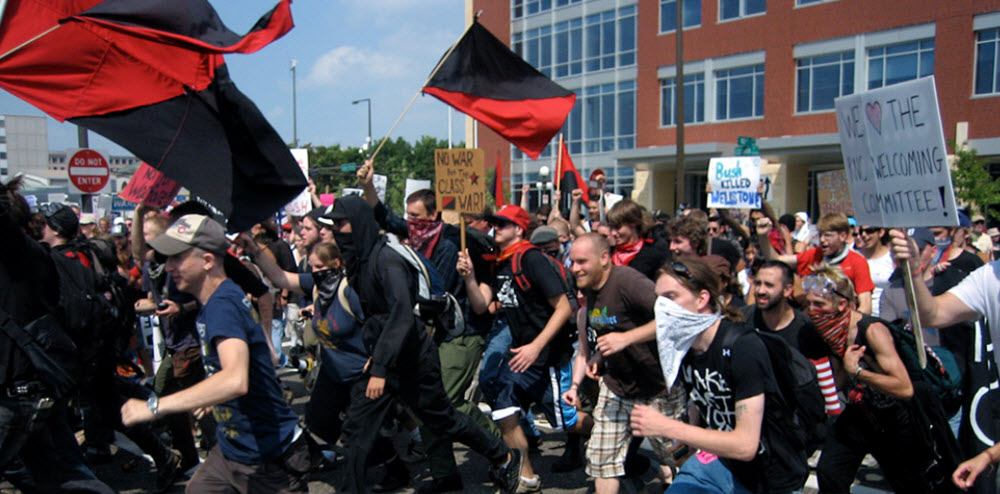
In part because of the media attention that Food Not Bombs garnered during their struggles in San Francisco, chapters began springing up all over the world. Food Not Bombs continued to gather strength throughout the 1990s, and held three international gatherings: in San Francisco in 1992 and 1995, and in Atlanta the following year. Chapters of Food Not Bombs were involved in the rise of the Anti-Globalisation Movement in the late 1990s, leading to the APEC resistance in Vancouver in 1997; the June 18, 1999 International Carnival Against Capitalism; and the Battle in Seattle later that year, which shut down the World Trade Organisation meetings.

Food Not Bombs has also been heavily involved in the anti-war movement which arose in 2002-2003 to oppose the 2003 invasion of Iraq.

Many Food Not Bombs groups recently moblized to provide direct aid in response to hurricanes Katrina and Rita. They operate alongside countless other groups operating without the restrictive bureaucratic structure of groups such as the Red Cross and Salvation Army.

Today, there are more than 500 chapters of Food Not Bombs all over the world, though most are concentrated in North America. Food Not Bombs has a loose structure: every chapter of Food Not Bombs embraces a few basic principles, and carries out the same sort of action, but every chapter is free to make its own decisions, based on the needs of its community. Likewise, every chapter of Food Not Bombs operates on consensus: everybody does an equal share of work, and has an equal say in making decisions. Besides collecting and distributing food for free, most chapters of Food Not Bombs are involved in community anti-poverty, anti-war organising, as well as many other political causes. Because most Food Not Bombs groups share the same values and because they operate in a generally anarchist fashion, Food Not Bombs is sometimes known as a "franchise anarchistic organization".

[edit] Repression and Surveillance

Countless FNB chapters around the world have been targets of brutality, arrests, surveillance and other forms of intimidation by various state agencies. This is an attempt to document those. If you have a story that is missing please include it with any sources you can provide.

During a presentation to the University of Texas at Austin in 2006, an FBI counter-terrorism official labeled Food Not Bombs and Indymedia as having possible terrorist connections. [1]

Since its founding in Cambridge, the Food Not Bombs movement has been met by state repression. Examples of surveillance and disruption of Food Not Bombs

In 1981, Food Not Bombs organized a peace march to Draper Laboratory in Cambridge, Massachusetts. Draper Laboratory was in the process of designing systems for nuclear missiles. The march was sponsored by Food Not Bombs and the Cambridge City Council. Volunteers first realized that Food Not Bombs was under government surveillance when the secretary of the City Council told them that a man from the CIA had stopped by and was looking for them just prior the protest.

Eight years later In 1989, just before the fall of the Berlin Wall and the end of Communism, the United States military held classes at the Presidio of San Francisco on domestic terrorism using Food Not Bombs as their case study, classifying the organization as one of "America's Most Hardcore Terrorist Groups."

One of the most widely reported examples of the government spying on Food Not Bombs came to light on December 13, 2005, when MSNBC reported that the Pentagon had spied on 1,500 peace protests in the United States from November through May of 2004. Tucson Food Not Bombs helped organize and participated in one of these protests.

The Department of Defense database, published by MSNBC, states that from November 19, 2004 to November 21, 2004 the Pentagon monitored the "Planned Demonstration at Fort Huachuca AZ Sierra Vista." They also listed it as a "Threat" and that it is "Open/Unresolved" and "Credible." One man who attended our November 19, 2004 meeting at a cafe in downtown Tucson seemed suspicious. When Food Not Bombs arrived at the protest three men stood at the door of the Food Not Bombs bus and took photos of each person who exited.


This isn't the only evidence we have that the government is spying on Food Not Bombs. The American Civil Liberties Union (ACLU) has published December 7, 2004 FBI Joint Terrorism Task Force (JTTF) documents about an FBI "routine" investigation into Food Not Bombs. A December 7, 2004 memo to the Denver FBI office from a Denver Squad 5/JTTF Special Agent reads, "Synopsis: To document information regarding Sarah Bardwell and Food Not Bombs."

It goes on to say "Details: as previously noted in serial 4, Colorado has several active Food Not Bombs (FNB) groups in Denver, Boulder, Fort Collins and Durango." (We are interested to see what serial 4 has to say about Food Not Bombs).

The memo continues, "On August 1, 2003, eight individuals were arrested at the so-called Denver FNB house at 1435 Lipan Street. The Charges included obstruction police/fire, disturbing the peace, resisting arrest and assault. These arrests were noted in this investigation due to (i) the close association between FNB and Anarchist Black Cross movement and (ii) the close proximity of the FNB house to 923 Lipan Street, the location of the Anarchist Black Cross Denver."

FBI memo about Food Not Bombs in Colorado

Denver Food Not Bombs house raided by police using mace

It is not clear why any association between FNB and Anarchist Black Cross would warrant the FBI to initiate this investigation. Anarchist Black Cross sends letters of support to political prisoners and on occasion they collect books to send to political activists sitting behind bars. The Food Not Bombs website and literature have stated that they work in solidarity with groups including the Anarchist Black Cross.

The FBI's interest in the lawful actions of Colorado's non-violent activists has had a chilling effect on movement. Due to this FBI investigation, many Denver activists became fearful, even to the point where it prevented them from exercising their Constitutionally protected right of free expression.

In the November 14, 2005 edition of Newsweek, Michael Isikoff wrote about the case of Food Not Bombs volunteer Josh Connole, "a 27-year-old ex-commune member who had been arrested - and later released - on suspicions he was one of the eco-terrorists who had fire bombed SUV dealerships in the summer of 2003." Mr. Isikoff reported, "The FBI collected detailed data on political activities and Web postings of suspected members of a tiny environmentalist commune in southern California two years ago as part of a high-profile counter terrorism probe, bureau records show."

The article states "Agents placed the commune under surveillance and developed a political profile of the residents, discovering the owner of the house and his father 'have posted statements on web sites opposing the use of fossil fuels,"9 one doc reads. Another says the owner had ties to a local chapter of Food Not Bombs, an 'anarcho-vegan food distribution group.'"

Shortly after Michael Isikoff's article, there were numerous other media reports about domestic surveillance on people who volunteered with Food Not Bombs. Karen Abbott of the Rocky Mountain News reported on December 8, 2005 that "The American Civil Liberties Union of Colorado said it will release documents today that show FBI agents improperly spied on peaceful protesters in Colorado Springs in the name of combating terrorism." In the article, Mark Silverstein, ACLU legal director in Colorado stated, 'These documents are further confirmation of our contention that the FBI's Joint Terrorism Task Force is wasting resources and threatening First Amendment rights by equating non-violent protest with what it calls domestic terrorism'.

Ten days later on December 18, 2005 two former Food Not Bombs volunteers were arrested in Arizona. Sarah Harvey was captured in Flagstaff, and Catalyst Bookstore co-founder Bill Rodgers was arrested in Prescott, Arizona on terrorism charges. A week later Rodgers was found dead in a Coconino County jail cell. They were arrested after being named by paid informants.

The Seattle Times reported on about Sarah's arrest on December 19, 2005, "An informant may also have led to the arrest in Arizona of Sarah Harvey, also known as Kendall Tankersley, who is accused of participating in a 1998 fire at U.S. Forest Industries in Medford, Oregon. The daughter of two attorneys, Harvey was homeless for a period in Eugene, and between 1997 and 1999 worked at Food Not Bombs, an agency that distributes food to the homeless, said Patricia Siering, a professor at Humboldt State University in California who met her years later."

Also all three California offices of the ACLU announced on December 21, 2005 that they had filed a Freedom of Information Act (FOIA) request from the California Anti-Terrorism Information Center on behalf of a number of non-violent community groups - including Food Not Bombs.

This case provides evidence that the government's warrantless spying didn't start started after 9/11 attacks. Food Not Bombs first learned that the police were wiretapping my phone without a warrant in a memo dated 1989. An internal police memo by Richard Holder claims, "During my investigation, I was able to obtain the private phone number of "Food Not Bombs" organizer, Keith McHenry, who unknowingly was a great asset to this investigation." How Mr. McHenry was "a great asset" to their investigation was and still is unclear. The memo reviews a phone conversation between Food Not Bombs co-founder C.T. Lawrence Butler and Keith McHenry. They were both excited because for the first time in Food Not Bombs history, we would be sharing food at protests in three cities on the same day.

Officer Holder got my home phone number from an informant who overheard me giving it to Starhawk after a meeting in Berkeley, CA. We never planned "to blockade all the entrances to the Presidio" and we didn't plan "to hold a meeting in the Page Street Public Library at 19:30 hours on 10/04/88 to discuss demonstration strategy and strategy for the upcoming permit hearing on October 20, 1988," as the memo claimed. In fact, we were simply invited to speak at the regular monthly meeting of the Haight Ashbury Neighborhood Council - where they planned to talk about organizing neighborhood support at a public hearing about sharing food and literature at the entrance to Golden Gate Park. Why they needed to send an undercover cop to this meeting is unclear.

The local police captain attended the meeting every month and his report was generally on the agenda of the City Council meeting. (The entire memo can be found below). During almost ten years of civil and criminal cases about the events in this memo no warrant was ever provided. A videotape of the protests clearly shows a San Francisco Police officer dressed similarly to Keith throwing a barricade at a line of riot police. It goes on to show the undercover cop pointing out people he felt should be arrested to uniformed officers The activists appeared upset with the undercover officer for pointing out the "leaders" to be arrested.

At the end of the tape, you can see six riot police throwing Mr. McHenry to the ground and lifting me by my arms and legs. This act of violence literally ripped my tendons and ligaments, leaving me to this day in constant agony. In a trial about this event, the police expert referred to this act of police violence as a "cross chest takedown." For Keith, it was the beginning of a series of similar police assaults that have contributed to his living in daily chronic severe pain that requires extensive medical assistance. He continues struggle every month to get the help I need and suffer hours and days of unbearable pain throughout my entire body

THE TEXT OF A SAN FRANCISCO POLICE DEPARTMENT WIRETAP MEMO Memorandum San Francisco Police Department To: Deputy Chief Frank Reed Patrol Bureau From: Acting Captain Richard Holder Commanding Officer, Park Station Date: Tuesday, 09/27/88 Subj:"Food Not Bombs" ISSUE: Activity update.

Discussion:

A. As per your request, I have conducted an investigation regarding the planned activity of the "Food Not Bombs" organization on October 15, 1988 at the Presidio. During my investigation, I was able to obtain the private phone number of "Food Not Bombs" organizer, Keith McHenry, who unknowingly was a great asset to this investigation.

B. "Food Not Bombs" current, and planned activity.

1. As part of a nationwide anti-war protest scheduled for October 15, 1988, "Food Not Bombs", plans to blockade all the entrances to the Presidio to support similar activity at the Pentagon and other military organizations. The goal is to shut down the Presidio all day by blocking and feeding demonstrators at the gates to the post. "Food Not Bombs" anticipates that this demonstration will draw more participants, 3000, than the last major demonstration at the Presidio on 03/26/88.

2. "Food Not Bombs" plans to hold a meeting in the Page Street Public Library at 1930 hours on 10/04/88 to discuss demonstration strategy and strategy for the upcoming permit hearing on October 20, 1988. Deputy Chief Frank Reed Patrol Bureau

Page 2 Subject: "Food Not Bombs"

3. In an effort to boost its strength "Food Not Bombs" has join forces with the Circle "A" Cluster group, the "Nuremberg Action" group, and the Walnut Creek Peace Center.

4. The founder of "Food Not Bombs", Lawrence Butler a.k.a. "CT" has flown in from the east coast to assist in the planning.

Concluson:

The currant activity of "Food Not Bombs" indicates that the group plans yet another confrontation with the police. The three groups now in alliance with "Food Not Bombs" are all involved in the Concord Naval Weapons Depot demonstrations, are all advocates of civil disobedience tactics, and non-cooperation with law enforcement agencies.

Recommodation:

A. That liaison be developed between the San Francisco Police Department Intelligence Unit, and Sgt. Ovid Holmes of the Contra Costa County Sheriff's Department Intelligence Unit. Sgt. Ovid has worked the three anti-war groups now in alliance with "Food Not Bombs".

B. That the Intelligence Unit monitor the October 4th meeting scheduled by "Food Not Bombs". attachments:


  • "Food Not Bombs" history
  • "Food Not Bombs" future actions
  • Anti-war group phone listings
  • "Food Not Bombs" menu
  • Blockade bulletin
  • "Food Not Bombs" information bulletin 002447

The "liaison (be) developed between the San Francisco Police Department Intelligence Unit, and Sgt. Ovid Holmes of the Contra Costa County Sheriff's Department Intelligence Unit." End of Memo

This isn't the only liaison that was developed in order to spy on San Francisco Food Not Bombs. Dan Evans of The San Francisco Examiner wrote an article printed on April 1, 2002 on "on the hidden workings of the Anti-Defamation League and how three Bay Area activists were able to uncover a spy operation that reached into the San Francisco Police Department." Mr. Evens goes on to say that "The files included Social Security numbers, driver's license numbers, addresses, phone numbers and group memberships. Some of the information was sold to foreign governments, including Israeli and South African intelligence groups." The list of files included two entries about Food Not Bombs under the heading "Pinko." San Francisco Police officer Tom Gerard worked in the departments intelligence division and provided information to Roy Bullock of the ADL. During the investigation into allegations of this spy operation the police entered Tom Gerard's locker at his office and discovered photos and documents showing that Gerard had worked for the CIA in El Salvador. Some of the photos show Tom Gerard standing next to a line of men sitting on chairs with black bags over their heads. Food Not Bombs received over 700 pages of this investigation, which included these pictures and documents. Evans goes on, "By his own admission, Bullock had been working off the books as a fact-finder for the ADL since the mid-1960's. He would infiltrate not only openly anti-Semitic groups, but also pro-Palestinian and anti-apartheid organizations, usually under false pretenses. Bullock, who is not Jewish, would then pass that information along to the ADL."

The article goes on, "He received information about his targets from former San Francisco Police Inspector Tom Gerard, who fled to the Philippines after being indicted in 1994 for illegal use of a police computer. Gerard's current whereabouts are unknown." Evans' story continues, "On April 8, 1993, armed with this information, police in San Francisco and Los Angeles searched the ADL offices in those two cities. In San Francisco, roughly 10 banker's boxes of information -- 75 percent of which officers said was illegally obtained -- were seized."

"A majority of data in those boxes confirmed police suspicions that it had come from Bullock's computer. On that computer was information on 9,876 people, including 1,394 driver's licenses. The files were divided into five categories: "Pinko," "Right," " Arabs," "Skins," and "ANC," the last standing for African National Congress."

On Tuesday, May 2. 2006 Food Not Bombs volunteers Laurie Churchill and Keith McHenry were taken off American Airlines flight 47 from Heathrow, England to Chicago-O "Hare. Two Homeland Security personel meet us at the gate, took us to a back area of the airport and surched our belonings and questioned them for an hour. They asked questions about their involvment with what they called " the violent group Food Not Bombs" These are only a few examples of covert surveillance of Food Not Bombs. Most regrettable is the fact that many of the worse violations of the rights of Food Not Bombs volunteers do not have a paper trail and can only be supported by testimony from reluctant participants. For example several employees with Chevron Oil, Wackenhut Security and other large corporations have shared a number of frightening stories about their companies efforts against Food Not Bombs but it's been impossible to obtain any corroborating documentation. However there is enough information available to prove that government and private covert surveillance and disruption are a reality. While we focus here on Food Not Bombs many groups including Earth First!, the Ragging Grannies, American Service Committee and many other community organizations can share their own stories of covert disruption by government and corporations.

[edit] Chapters

Chapters with Websites

[edit] Further reading

[edit] External Links

[edit] Other Links

Image:Fnb button.gif Food Not Bombs Guide This term is part of the Infoshop Glossary

Personal tools