Confronting Global Capitalism and Challenging White Supremacy: thoughts on movement building and anti-racist organizing
by Chris Crass
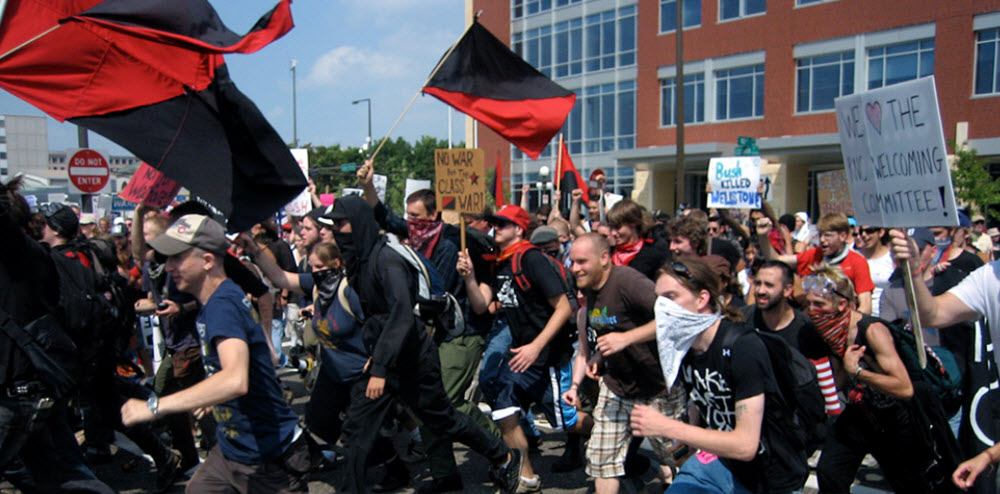
One of the most exciting developments that has come out of the mass actions
in Seattle against the WTO and in Washington DC against the IMF/World Bank
is the movement-wide discussion about racism, white supremacy and
organizing strategies to build a multiracial movement opposed to global
capitalism. Elizabeth 'Betita' Martínez's widely distributed essay, "Where
Was the Color in Seattle", put forward the question - why, if global
capitalism has the greatest negative impact on people of color around the
world and in the United States was the protest against the WTO so
overwhelming white (about 95%)?
In the political punk zine HeartAttack, Helen Luu wrote about the
whiteness of the protests in Seattle as well as the general radical
left/anarchist movement. Luu writes, "Here was this white girl telling
about what happened in Seattle and telling about what happens during the
'average' direct action as if her experience as a white, middle-class
female applies to everyone. Of course, there was no mention of the lack of
colour in the crowd of protesters. And never does it occur to her that
while police brutality represented Seattle '99, it happens to represent
everyday reality for blacks, Chicanos, etc." Luu then goes on to discuss
how middle class white activists often have the privilege to choose issues
and to choose tactics and that they generally have less to lose by engaging
in activism. People of color, on the other hand, generally have to focus
their activism on survival issues - like police brutality, housing, welfare
rights, environmental toxins next door - that impact their lives and
communities in concrete ways. Luu argues that we need to rethink the way
that we define activism and I would argue that white radicals need to
seriously examine how we talk about issues and tactics, in terms of what is
deemed militant and what issues are described as radical, in relationship
to how white supremacy operates.
The discussion of how white the anti-global capitalism movement is was
continued in the new anarchist journal out of Chicago, the Arsenal. Jason
Wade and Steve Stewart, in their article, "The Battle for our Lives", write
that anarchists must develop analysis that connects sweatshop labor in
Indonesia to sweatshop labor in the United States and demonstrate that
global capitalism creates misery in the third world and misery in the
United States as well. They write, "We need to take the momentum from the
anti-global capitalism struggles and connect them with struggles against
police brutality, for health care, against welfare cutbacks, for better
access to education, struggles that grow from our neighborhoods and build a
serious revolutionary critique, vision and movement to redistribute power
back to our everyday lives." They argue, "We have to struggle around these
'everyday life' issues if we hope to build a more multiracial movement."
As I write this article, the radical activist movement is gearing up
to take on the Republicans and the Democrats at their national conventions
in August. The mass mobilizations will again bring activists out to
confront illegitimate authority that punishes the planet and the majority
of its inhabitants in it's quest for profit and power. The mobilizations
have focused on making the connections between international issues and the
impact at home in the United States. While protesting the two parties of
capitalism at their conventions is a significant goal in and of itself -
these actions are also part of building our movements for social change.
An essay in the anarchist newspaper, Love & Rage, that came out in '97
discussed ways that we could be organizing to oppose global capitalism. In
the article, "Neo-Liberalism and World Revolution", Chris Day writes,
"Neo-liberalism [the ideology of global capitalism] places new demands on
the revolutionary movement, but it is also creating new opportunities. The
possibility for linking up people in various struggles that previously
would not have been aware of each other is a profound threat to the rule of
international
capital. Any local struggle could capture the imagination of people around
the world. A demonstration in Atlanta, a strike in Armenia, a riot in
Algeria could spark sympathy actions in the most remote corners of the
world. This threat is greatly amplified by the creation of organizations
that have spreading struggles around the globe as their primary purpose."
This is what we witnessed in Seattle and in Washington DC. This is what we
are participating in as we organize on many different fronts and work to
develop common analysis of injustice, common strategies for resistance and
common visions of liberation. The possibilities for movement building are
in front of us.
When I think about and imagine the kind of movement that I want to be
a part of it is: multiracial and absolutely dedicated to self-determination
for all oppressed people and ending white supremacy ; feminist with a
commitment to develop new social relationships based on equality and bring
down the social structures based on domination - for women's liberation and
queer liberation; multigenerational and full of energy and wisdom and a
desire to make healthy communities for all of us to care for and learn from
each other; anti capitalist with a deep analysis of how the system deforms
and dehumanizes us joined with a vision of a new order based on cooperation
and ecological sustainability; and anarchist with empowerment, new
strategies of organizing and solidarity building at its core. So, the
question is - how do I organize.
thoughts on anti-racist organizing
When Elizabeth 'Betita' Martínez wrote her essay "Where was the Color in
Seattle", she said that the most frequently asked question by white
activists was, "how can we get people of color to join our group?" This is
the wrong question. The question is, "How can we be an anti-racist group
dedicated to bringing down white supremacy". White activists need to work
on developing our understanding of racism, how white privilege operates in
the activist movement and how we can bring a solid anti-racist politics to
the work that we do.
The idea that we just need to get more people of color to join our
groups is an example of how white privilege operates. It carries the idea
that we have the answers and now it just needs to be delivered to people of
color - as oppose to, people of color have been organizing for a long time
and we (white activists) have a lot to learn so maybe we could find a way
to form alliances, relationships, and coalitions to work with folx of color
and be prepared to
learn as well as share. The other major aspect of 'how can we get more
people of color to join our group' is the idea that anti-racist
consciousness develops through osmosis - i.e. white people sitting in the
same room as people of color will begin to understand how white supremacy
operates and therefore we won't need to really talk about it.
There is certainly truth to the idea that white people learn about
racism through interactions with people of color or from being in the same
situations. I've learned an enormous amount that way - but in terms of how
we plan to do this work in activism, our goal cannot be to bring in people
of color and expect that they will school us or that dynamics will begin to
develop that we can learn from. If it is education we want - then we need
to go to more events and actions organized by people of color and show
support, listen and learn. We can read the amazing writers that are out
there. We can pay attention to how the system works (when we are in jail,
in court, in classrooms, and on the street). We can build relationships
and learn from each other. But, just as men cannot expect women to educate
them about sexism and heteros cannot expect queers to give them the
homophobia 101 class whenever it is deemed appropriate - white people have
a responsibility to work on racism together and not wait until a person of
color brings it up.
Here's an example of this kind of dynamic. Men in Food Not Bombs (the
group I've worked with) would often talk about sexism in terms of how can
we get more women taking on more responsibility and create equal power.
The conversations would sometimes turn to how can we check our behavior
that is preventing women from taking on responsibility, what kind of
internal culture do we have and how does it privilege men and keep women
down. These conversations were very useful - as men should worry less
about what women are and aren't doing and think more about what they as men
are and aren't doing - the women in the group are just as capable, just as
responsible, just as intelligent, once men stop occupying all of the space
and learn to share power. Men worrying less about appeasing women and more
about ending sexism is what must happen. This is how we need to think
about racism - too often I hear white activists talk about why more people
of color aren't in the group - as opposed to whether or not we really have
an understanding of how deeply racism impacts the issues we're working on
and whether or not there are organizations and activists of color already
working on these issues so that we can form working relationships.
White radicals also need to think about how we go about forming
working relationships with people of color. Gloria Anzaldúa, queer Chicana
author/activist, writes about how white activists often talk about helping
other people - helping the people at Big Mountain, the farm workers,
indigenous communities working to keep toxins out of their neighborhoods,
political prisoners, etc. Anzaldúa writes, as they (white folx) learn our
histories and understand our struggles, "They will come to see that they
are not helping us but following our lead". This is a major distinction -
no white savior coming to make it all better, but rather white allies
working in solidarity with people of color in a way that respects
leadership and builds trust and respect.
White activists finding ways to show solidarity and act as allies with
people of color is critical. It's not about helping other people with
their issues, but rather taking responsibility for racial injustice and
recognizing how we are impacted by the issues - as Black feminist
author/activist Barbara Smith says, "In political struggles there wouldn't
be any 'your' and 'my' issues, if we saw each form of oppression as
integrally linked to the others."
The struggle against racism for white people might be thought about in
at least several ways. One, white privilege is the flipside of racial
oppression and each must be challenged if we are to move towards equality.
Two, when people of color oppose racism they are also re-affirming their
humanity in a social order that denies this and that is why struggles
around racism have been such catalysts for revolutionary social change
because they challenge the very foundation of this society - white
supremacy. White radicals need to think about ways of talking about and
organizing against white privilege - in the movement and in general white
society. White radicals need to think about how organizing against racism
is also about freeing our humanity from the grip of the slave society.
There are two main ways that white people are generally organized
around race in the United States today - guilt and fear. The worst of the
left uses guilt as a way to motivate people to take action - which may have
short term results but does not build a movement with a positive long-term
commitment to collective liberation. White guilt is an obstacle to social
change and needs to be overcome and transformed into responsibility to take
action to end injustice which damages all of us to varying degrees. The
worst of the right uses fear - fear of 'brown bodies' crossing 'white
borders' with 'illegitimate and illegal brown babies' sucking up 'white tax
dollars' in the 'Black controlled welfare departments' of 'juvi-crime
ridden inner cities'. Fear has been successfully mobilized over and over
and white radicals have a responsibility to understand that fear and
transform it into an understanding of the structures which deny most white
people control over their lives.
This is an exciting time with great possibilities and we need to be
ready to make mistakes, make hard decisions and experiment with anti-racist
organizing that really does aim at challenging white supremacy in
conjunction with confronting global capitalism.
chris crass is an organizer with Food Not Bombs and the Challenging White
Supremacy Workshop in San Francisco
Discuss this article at the infoshop.org phorum
|