|


Stick It To The Manarchy
by Maggie, Rayna, Michael, and Matt
The Rock Bloc Collective
Bard College
rm479@bard.edu
http://nyc.indymedia.org/display.php3?article_id=2566
Manarchy: Aggressive, competitive behavior within the anarchist movement
that is frighteningly reminiscent of historically oppressive male gender
roles. Such behavior includes acting macho, holier than thou, and
elitist. Manarchy often results in exclusivity.
We feel obliged to share our discomfort with manarchy as it presents
itself in the anarchist movement. We are excited and inspired by the
development and practice of anarchist ideals, and we must remain
critical of our movement in an effort to maximize our effectiveness.
Anarchism and direct action are powerful forces, yet we are still
susceptible to taking on some of the oppressive cultural practices of
the very system we are challenging.
We are two women and two men, all white and coming from economically
privileged backgrounds. We are anarchists. We support direct action
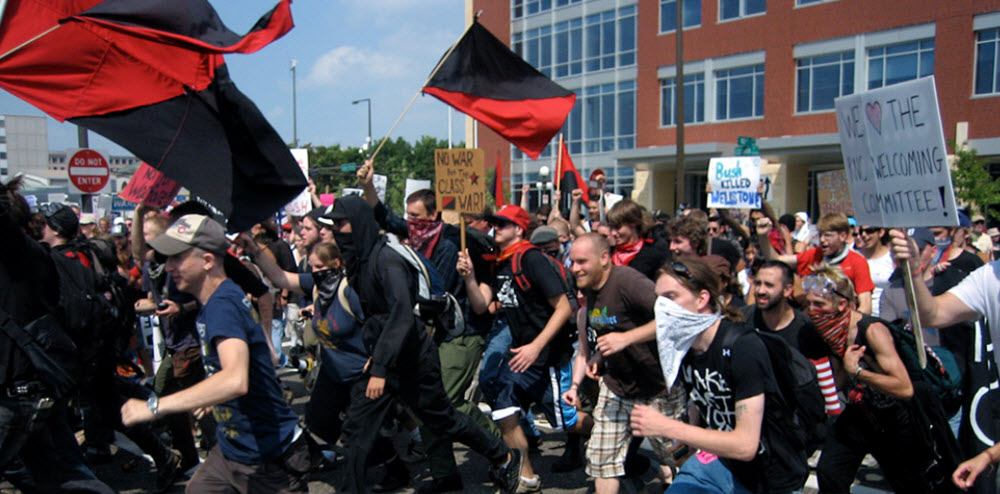
and the Black Bloc as a tactic for empowerment. In this article we focus
on what has been coined “manarchy.” We intend to explain and criticize
manarchist behavior by running through a series of experiences that we
have had at mass actions, conferences, and in our day-to-day organizing.
Most insidious is the dogmatism of ‘no compromise' that is often
accompanied with a macho spirit that assumes a ‘tougher than thou'
attitude toward dominant culture as well as allies in the movement.
At the presidential debates in Boston, one of us saw a group of people
bust through a police barricade of an already blocked off street. The
move was far-fetched and ill planned, and resulted in several people
being pepper sprayed. This is tough, not tactical. For some of these
people, being pepper sprayed became a battle wound that illustrated
their no-compromise “radical” politics.
In a similar vein, two of us were at a Black Bloc meeting where one man
declared: “If you're not willing to take a hit [to the head with a
baton] and you're not willing to go to jail, don't march with the Black
Bloc.” He was frustrated with the fact that he had been marching with
the Black Bloc at the Inauguration protests and upon confronting a
police barricade, found that no one was backing him up. We question
whether sacrificing oneself to a beating is an effective goal. We
cannot overemphasize the importance of protecting each other, yet we
also understand that people in different situations have different
needs. In other words, not everyone can and wants to get beat up and
sent to jail for an act that may or may not be perceived as tactically
useful.
The man's divisive statement assumes that he is one of the more
qualified Black Bloc participants in the group. He found that no one
else had stuck around to take a beating with him, demonstrating that he
is tougher and, therefore, a better radical than others. His superior
position –his statements suggest– gives him the authority to declare who
is allowed to march in the Black Bloc. Thus, he feels comfortable
telling others to stay home.
The no-compromise position has been exemplified by a posting on the
Independent Media Center's website. In a critique of the Inauguration
Protests in Washington, D.C., Slip writes:
"i think we really need to ask ourselves what our militancy means? is it really
militant to allow to be searched to enter into the are that you
were scheduled to have your first amendright right? that's not militant
or defiant. is revolt if you ask for permission for the same system
you are protesting? permited protests are in no way a resistance,
let alone a revolution. to me, in this revolution the ends ARE the
means. we have to live our visions and take control of our own lives.
this is exhibiting in not just how we live our lives, and use our
lives as tools, but how we extend our dissent into literally reclaiming
our spaces, when we get into the streets. we can no longer pander
and go through "the proper means" the proper means are practicing
real democracy and claiming our right to free assembly. NO COMPROMISE."
(http://indymedia.org/front.php3?article_id=24345&group=webcast)
In this critique, Slip raises an important point about the need for
militancy, defiance, and fundamental subversion of the system. Yet, his
analysis around “NO COMPROMISE” remains problematic. In a capitalist
system, we all must compromise. No one is perfect, and we are all
implicated with the oppression that this system is built on. Some are
more implicated and privileged than others are. It's ironic that the
more privileged are often the ones who make the call for “no compromise”
at mass actions. We should question who is able to “not compromise” at
large demonstrations. For example, as four white, college students,
it's pretty easy for us to be militants at mass actions. In addition to
easy access to lawyers, the cops and courts treat us better than classes
of people who are traditionally victimized. It is much harder for
people of color, the economically disadvantaged, and people who are not
physically capable of intense physical confrontation to take such a
position.
Ultimately, we find the “NO COMPROMISE” position compromises a
significant part of our ideals. We are working to build a world where
people are empowered and loving. However, manarchist militancy tends to
insult allies in the movement rather than act in solidarity. The
narrative of non-compromised purity reminds us of the elite members of
college fraternities saying, “you're not macho enough” and the Christian
Right saying, “you're not holy enough.” It is simply a form of
chauvinism that divides people.
The intersection of the militancy and no-compromise position is
strikingly similar to the martyr ethic of the religious movement's call
for civil disobedience. In this tactic, people sacrifice themselves for
a greater cause. In the past few years, civil disobedience has come
under fire by radicals calling for tactics that are less cooperative
with the system and more empowering and inclusive for the participant.
Yet, manarchist reasoning has gone full circle; jail time and battle
wounds have become the new self-sacrificial disobedience.
We would also like to note that religious movements calling for civil
disobedience tend to emphasize love, while manarchists emphasize
aggression. Five Days That Shook the World, a book written within the
movement about “Seattle and Beyond”, celebrates direct action
participants as “street warriors”. The Random House dictionary defines
warrior as “1. A man engaged or experienced in warfare; soldier. 2. A
person who has shown great vigor, courage, or aggressiveness, as in
politics.” In the context of which we are critical, a warrior is a
self-proclaimed hero, dogmatic and competitive.
We do not romanticize the image of the non-compromising militant, ready
to take anything on in the name of the cause. We are not Rambo. We are
not the Navy Seals. We are not heroes. We are anarchists, building a
space that is empowering, accepting, inclusive, accessible,
communicative, and community oriented.
To build the movement we must be more than merely relentlessly
physically rugged, devoted to the cause, self-sacrificial, and
militant. Those who cannot afford – monetarily, physically, or
emotionally – to risk arrest, lawsuits, of physical assault are excluded
from this club. This means that many women, people of color, the young
and elderly, and the economically disadvantaged do not have what it
takes to participate in the manarchist revolution. Is this a revolution
to benefit the participants who are mostly middle/upper class white
males, or is this a revolution of young warriors sacrificing themselves
for the good of the women and children they exclude? Both are
unacceptable.
Mass actions are only one part of anarchist organizing. However, when
they occur they should feel like gatherings where people are empowered,
enjoying themselves, and in solidarity with their allies. Marching in
the Black Bloc we have found many are tough enough to get hit on the
head, but not open enough to say hello, let alone communicate tactical
ideas, need, or feelings. This embodies the typical male gender role.
If one wants to be a street warrior, we urge the warrior to direct his
or her negative energies at the system and contribute positive feelings
back to the movement.
Rather than the motto, “NO COMPROMISE”, we call for “whatever works.”
And if that sounds too cold, we suggest, “Live the Revolution.” Quite
simply, we urge our comrades to more carefully evaluate how our actions
will affect our targets, capitalism, and oppression. We are not
critiquing militant tactics, nor are we critiquing people who use them.
We are calling for people to step outside the manarchist dogmatism and
use tactics as they are useful.
We see importance and value in alliance building, discussing ideological
and tactical differences, and understanding and respecting each other's
varying opinions. If a movement is uniform in all its tactics and
ideologies, it is not only boring, but vulnerable to extinction. We
need to work with those who have different opinions, while recognizing
our common goals and organize in a way that respects and acknowledges
difference through communication.
We hope this article helps to open up discussion. We encourage people
to respond. Please contact us personally as well as publish your ideas.
Maggie, Rayna, Michael, and Matt
The Rock Bloc Collective
C/O the Student Action Collective
Bard College
Annandale-on-Hudson, NY 12504
rm479@bard.edu


last updated: February 6, 2006
|