|

Buy
Infoshop gear and more at our online store.

Donate to Infoshop and Practical Anarchy magazine.
|


Another World Is Possible . . . But What Kind, and Shaped By Whom?
by Cindy Milstein
During the World Economic Forum (WEF) meeting and related demonstrations in
New York from Jan. 31 to Feb. 4, the Village Voice put its finger to the
shifting political winds. That week's cover headline read, "Passing the
Torch: Anarchists Pick Up Where Progressives Left Off," and the corresponding
image depicted a middle-aged white male running in a business suit while
handing off a Molotov cocktail to the young white male in "anarchistic"
attire sprinting along behind him. While this front page could be critiqued
for its damaging stereotype--that all anarchists are youthful, violent
Caucasian guys--the article inside sympathetically acknowledged that "the
anarchist fringe is fast becoming the movement's center." Anarchists are
indeed outstripping progressives because they offer a form of contestation
and transformation that speaks to the times--a form in explicit opposition to
the world's powerful elites, but one that also acts as a thorn in the side of
many social justice activists.
This is especially apparent when comparing the WEF to its critics: the
simultaneous gathering in Porto Alegre, Brazil of the World Social Forum
(WSF) and the anti-capitalist convergence on NYC's streets.
The WSF maintains in its slogan that "another world is possible." It is
in fact not only possible but certainly probable, given that the process
known as globalization, among numerous other remappings, is fundamentally
reconfiguring power relations. And far from settled, the ability to (re)shape
the world is being both openly and surreptitiously fought over by
nation-states as well as transnational corporations, nonprofit organizations
as well as the millions ravaged by the globalizing process, and many others.
Some potential worlds could, of course, be more dystopian than today's--say,
those asserted to be the divine word of a god or prophet by fundamentalists
of all creeds. Yet even the more humane visions, like that of the WSF's, beg
the questions, Whose world will it ultimately be? Who will make social,
economic, political, and cultural decisions, and how? While there are
multiple answers, they all emanate from one of two distinct poles of
governance: centralist vs. decentralist, or to put it more starkly,
authoritarian vs. anti-authoritarian.
Of all the new authoritarian models, the WEF's can be said to be the most
avant-garde. The WEF is ahead of its day in forging an organizational culture
and structure capable of stylish world dominance in the age of globalization.
It is certainly not alone in its quest to "further economic growth and social
progress" for a limited few--social progress being measured by economic
growth. Institutions from the World Bank to the European Union to the U.S.
government share the same pursuit. What sets the WEF apart is its innovative
means, potentially making it all the more dangerous. To borrow its own
language, the WEF's membership meets in "a unique club atmosphere," always
luxurious, "to shape the global agenda," "to mold solutions," with the aim of
controlling sociopolitico-economic processes to its own advantage.
Such maneuverings have been militantly challenged at the WEF's past
couple annual meetings in Davos, Switzerland. Part of the alleged reason the
WEF ventured from its secluded retreat for the first time was to avoid this
mounting resistance. The social costs, especially for the Swiss authorities,
had gotten too high. WEF leaders also likely hoped to discredit such
opposition altogether by meeting in New York City so soon after Sept. 11.
They could claim to be both mourning the dead and doing their bit to rebuild
NYC by convening at the opulent Waldorf-Astoria hotel. In contrast, so the
WEF probably assumed, the protesters would be seen as funeral crashers,
dishonoring the dead by running wildly through the streets of a still-
grieving city without regard for property or propriety. Resistance would be
irrevocably tainted, thereby allowing institutions like the WEF to go about
the lofty mission of governing capitalist society without any pesky
interference from "anti-globalist marginals," to cite one WEF member.
To extend these speculations further, though, the best reason for
trooping to Manhattan was to highlight the growing global influence of this
relatively small, young organization. As 9-11 and the subsequent anthrax
scare revealed, fixed and visible centers of power can be targeted and
attacked. The physical homes of those institutions that have played such a
large role in determining the postwar world economy (like the New York Stock
Exchange) and geopolitics (like D.C.'s Capitol building) are at risk of being
shutdown. The U.S. government, complacent with overconfidence in its own
preeminence, still has the might to lash out violently at home and abroad,
yet like all bloated empires, it tries to preserve its authority in the same
tired ways, even as its leaner adversaries dream up new strategies to assume
the mantle of global power broker. It could thus be argued that the WEF came
to NYC precisely because Sept. 11 exposed America-the-superpower's
vulnerability, thereby allowing the WEF to flaunt itself as heir to
institutions like Wall Street and nation-states. Or at least hold itself up
as a potentially more resilient form of domination--flexible, savvy, and
placeless.
The WEF boasts of being a trendsetter, and indeed it is. Started as a
nongovernmental organization (NGO) in 1971, it brings together the best and
brightest of the global power elites: 1,000 business leaders, 250 political
leaders, 250 academic leaders, 250 media leaders, along with a sprinkling of
labor, social justice, and entertainment leaders. They are leaders not
because an electorate or the public says so but by virtue of their wealth,
influence, and power, and their farsightedness in being able to maintain all
three. This ensures that those most adept at foreseeing where the globalizing
world might go, and hence most able to engage in steering its course, will
constitute the WEF's fluid and, if needed, easily rearranged membership
(witness the summary disinvitation of Enron's Ken Lay). These privileged few
are bound to neither space nor place, geography nor nation-state. They are
accountable only to themselves, and when it serves their self-interests, each
other. In the WEF's own words, this NGO "is tied to no political, partisan or
national interests"--although "beholden to" would be more descriptive. It is
as transnational and elastic as the form of capitalism it promotes. And in
its extremely exclusive, private global clubhouse, glamorous hobnobbing among
WEF members legislates real-world economic and social policy.
Take just one iconic participant: Bill Gates. Money can't be his only
goal; for eight years, he's been the world's richest individual. More
pointedly, having achieved the near-monopolistic power to determine how
humanity communicates electronically, Gates has now taken a philanthropic
turn. He is busily deciding health care policies for whole countries and even
continents by funding his version of wellness. This grand gesture includes
creating mass dependency on a healthy dose of his corporate buddies' designer
pharmaceuticals, particularly after Bill's donations run out. Even if he had
only benevolent motivations, can one person know what's best for billions of
peoples' bodies? As radical feminists have long contended, control over one's
body relates to self-determination and social freedom as well as health.
The "representative" democracy of many nation-states almost begins to
look good by comparison, at least as a way to keep the WEF in check. But
these same allegedly democratic countries, along with a host of blatantly
undemocratic ones, are partners in and frequently under the sway of the WEF
itself. Even at the tender age of three, the WEF could already claim in 1973
to have "grown from humble beginnings" to be "the leading interface for
global business/government interaction." Now in its yuppie prime, this NGO
has developed its muscle by integrating countries--from those in Latin
America, the Middle East, and Africa, to Eastern and Central Europe, Asia,
and even North America--into its institutional frame, often well ahead of the
so-called international community. As the "premiere gathering of world
leaders in business, government, and civil society," an autonomous
supranational body such as the WEF looks to limit the power of nation-states,
not vice versa, and increasingly has the clout to do so. This is the hazy yet
ever-sharper organizational outline for a potential form of one-world,
nongovernmental governance, where a handful of individuals judge right and
wrong by the bottom line of buy-sell relationships, unimpeded by
constituents, much less ethical considerations, cultural constraints, or even
anti-capitalist convergences.
In this context, the WSF is held up as a promising candidate to stand
against the WEF and campaign for a better world. Pulled together by eight
NGOs as the socially oriented counterweight to the WEF, the WSF first
convened last year in Porto Alegre during the WEF's Davos session. This year,
the Brazilian meeting again purposefully coincided with the WEF's. As a
"forum for debate" for all who seek an "alternative to [the] neoliberal
model," the WSF "brings together and interlinks . . . organizations and
movements of civil society from all the countries of the world" along with
"those in positions of political responsibility, mandated by their peoples,
who decide to enter into the commitments resulting from those debates."
Certainly, the WSF and those who participate in this alternate forum place
"special value on all that society is building to centre economic activity
and political action on meeting the needs of people and respecting nature,"
to again cite the WSF. And much-needed social justice work has and will come
out of the WSF's relatively (in comparison to other global gatherings) open
meetings.
But wittingly or not, in trying to parallel the WEF's meetings as its
alternative, the WSF ends up mimicking its hierarchical structure: a
supranational, nongovernmental body that seeks to shape the global agenda,
with no accountability to and far removed from those whose daily lives are
affected. Like the WEF, the WSF offers an informal, fluid, and centralized
networking environment for the globally influential--in this case, those in
the "nonprofit" and "movement" sectors. Such influence on the world stage, as
the WEF wells knows, can soon translate into a power that rivals or exceeds
that of nation-states.
Once the WSF's annual meeting is seen as the premiere gathering of
socially concerned leaders, which in two short years is already becoming
apparent, its statements will carry extraordinary political weight and its
"debates" will soon map out public policy. Big, bureaucratic NGOs will
continue to flock to the WSF in ever- greater numbers; and unlike activists
and community-based organizations operating on a shoestring, they will be
able to attend meetings annually and serve as members of the organizing
council in between. These NGOs, then, will largely set the themes and
strategies discussed at the WSF, limiting from the start the concerns of
grassroots groups and radical movements. Moreover, these NGOs have the
financial and organizational resources to, at a minimum, lobby governments
and corporations--who are often involved with or monetarily supportive of
these NGOs--to implement their notions of social change, thereby assuring that
any "change" accords nicely with the status quo. Or a la Gates, the NGOs can
attempt to directly implement the ideas they themselves have developed at the
WSF's annual gathering through global social service projects. Since these
NGOs have their own agendas, such projects will always carry political,
social, and/or cultural price tags. This might not be a problem were it not
for the fact that as private, nongovernmental bodies, NGOs don't have to
worry about participatory processes, accountability, or transparency. So much
for representative democracy, much less community control or even public
scrutiny.
As the WSF gains in global influence it will even be courted, as it
already was this year, by the very entity it set out to challenge, the WEF,
which is perhaps able to recognize a kindred spirit well before the rest of
us. This may have something to do with the WSF's mission itself, in that it
neatly inverts that of the WEF's. Whereas the WEF views everything through an
economic lens, and is thus concerned with social issues insofar as they
hinder economic growth, the WSF views everything through a social lens, and
is thus concerned with economic issues insofar as they hinder social justice.
The WEF, for instance, troubles itself over a lack of water, education, or
transport in countries because these basic necessities serve as vital
infrastructure for economic expansion. (Besides, the utterly destitute don't
make particularly robust markets and can even get unruly.) Conversely, the
WSF strives to reduce economic exploitation because it limits peoples' access
to essentials like jobs, food, or housing. Socioeconomics, or more precisely
capitalism, can therefore be utilized for opposite ends: in the WEF's eyes,
it is good for business; in the WSF's, it can instead help bring about social
justice. The WSF displays the best of aims: to meet human needs in a just
manner. But because it accepts only those possibilities obtainable within a
capitalist society (say, higher wages) rather than those that may be
generated by but also dismantle present-day social relations (like the end of
the wage system altogether), the other world that is possible is already
circumscribed, already damaged.
Such thinking leads the WSF to attempt to ensure social equity by
partnering with nation-states and international agencies. For example, the
WSF was joined this year by the Forum of Local Authorities (including
big-city mayors and administrators) and World Parliamentary Forum. These
political leaders come from the same countries sending participants to the
WEF; most political leaders have friendly if not intimate ties to the
military-corporate complex via investment, consulting, or board of director
seats; and they represent the same political entities that help perpetrate
social injustice. True, the WSF hopes to heighten citizen participation in
"democratic" (representative) nations and international bodies, and this
would likely be an improvement for many people, but more input is
nevertheless a far cry from actual power. "Participation" is the polite way
of squashing popular movements by making people feel they finally have a
place to be heard by those in positions of authority, who listen carefully in
order to incorporate just enough of people's concerns to neutralize their
discontent. But those at the top still get to have the final say. A glimpse
of this strategy can be seen in the WSF's International Council, which
resolved on Jan. 28-29, 2002, to continue to hold the "annual centralized WSF
event," but as "the WSF takes on a worldwide character and acquires more
support [that is, power], there must be more mobilization in the regions to
encourage more participation from all the continents."
If unaccountable, free-floating supranational bodies like the WEF and WSF
prove themselves better able to determine "public" policy than so-called
public servants elected in democratic republics, participation becomes even
more meaningless (leading some to the regressive demand to strengthen
nation-states). An influential few will have set themselves up as untouchable
"leaders" more capable of knowing what's good for humanity than the vast
majority of the world's peoples, who will be completely shut out of shaping
the societies they want to live in. Indeed, eerily similar to the WEF's
notion of a "corporate citizenship" voting on the allegedly better society,
the WSF proposes a "planetary citizenship." Who, pray tell, would govern this
global citizenry?
Lost in the WSF's mission to bring about social justice, no matter how
noble, is the very notion of freedom itself, of self-determination and
self-governance, without which there can be no social justice. Surely the
possible world of the WSF would be far preferable to the WEF's. Yet in
attempting to oppose the WEF, the WSF only succeeds in offering a kinder,
gentler version of top-down decision making, and hence offers no real
alternative at all.
Which brings us back to the anti-authoritarian "keepers of the flame"
explored in the Voice article mentioned above, where writer Esther Kaplan
observes that anarchists don't oppose "the WEF just because their policies
exploit the poor, but because their power is illegitimate. [Anarchists]
envision an egalitarian society without nation states, where wealth and power
have been redistributed, and they take great pains to model their
institutions in this vein." David Graeber echoes this in his recent In These
Times piece: the anti-capitalist convergence during the WEF meeting held out
"new forms of radically decentralized direct democracy [as] its ideology. If
nothing else, the 'bad' protesters have managed to prove that they can do
anything the (hierarchical) NGOs or unions can, probably much better."
As NGOs and social justice activists bailed out of the WEF demonstrations
from fear in the post-Sept. 11 climate and/or the desire to be part of the
more high-profile, safe WSF in Brazil, a variety of anti-authoritarians were
handed the reigns of the U.S. direct action movement (re)birthed in Seattle.
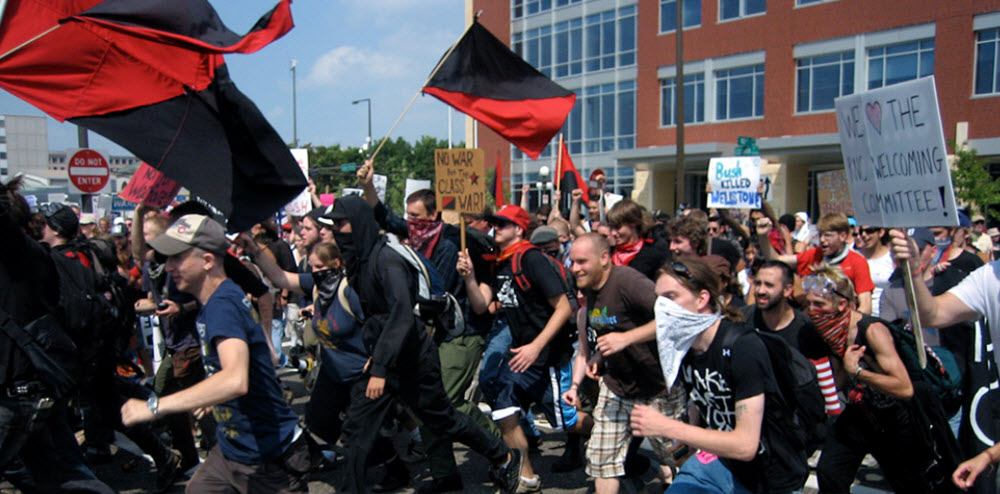
They became the main organizers and spokespeople for the pivotal NYC
convergence. Thus, even the mainstream media were forced to cover anarchist
beliefs and visions--which, of course, have been there all along--if they
wanted to report on the convergence at all. So despite the usual
demonizations in the corporate press (as in the case of another Voice
article, titled "Law of the Fist," that basically labeled anarchists
"Al Qaeda-like"), it became a fairly universal assertion that anarchism was
openly opposed to capitalism and just as openly for direct democracy. This
was especially so among the participants themselves. While for
anti-authoritarians direct democracy can include everything from collectives
and affinity groups to worker and/or neighborhood councils, acting in
networks or confederations that keep power at the grass roots, most concur
that self-governance must be part and parcel of present as well as future
forms of social organization. Nowhere at the North American convergences of
the past few years has this been more palpable, more public.
Instead of signaling the death knell for resistance and reconstruction,
New York's demonstration may just have "normalized" anti-authoritarians'
notions of social and political contestation, whether one is an anarchist or
not. The use of substantively participatory decision-making processes before
and during the WEF convergence, while not perfect, were nonetheless able to
settle on street tactics that were sensitive to the feelings generated by
Sept. 11, especially in NYC, and hence thoughtfully somber and restrained.
Though comparatively dull for the marchers, not to mention the media and
police, this explicitly anti-capitalist event not only reasserted that
resistance is permissible again after 9-11's tragedy but that it is
increasingly necessary and courageous in light of new, rapidly consolidating
forms of global authoritarianism. More important, it helped to vindicate and
validate liberatory alternatives.
Such alternatives have of late flickered momentarily though brightly at
anti-capitalist convergences and in localized anarchist projects, but also in
everything from the spontaneous gatherings of diverse New Yorkers in Union
Square right after Sept. 11 to the banging of pots and pans during protests
in Argentina by the middle class. Catalyzing the desire for
self-organization, however, is not enough. As the WEF's and WSF's of the
world duel it out to gain centralized power for themselves, anarchists must
struggle for popular self-government as a dual form of power, and support
those who are doing likewise.
The Zapatistas, along with other revolutionaries before them, have
already shown that declarations of "democracy, freedom, justice" resonate.
But they have proved as well that municipalities can strive to become
autonomous from statecraft and capital, to put human and ecological concerns
first, while retaining regional and global links of solidarity and mutual
aid. Such is one form of dual power emanating from an anti- authoritarian
vision of social transformation. There are now hints of others, still in
their infancy: the European Social Consulta (ESC) and the neighborhood
assemblies in Argentina. While the ESC is being intentionally organized by
those who already consider themselves radical and the assemblies have been
organically established by many who have never seen themselves as political
before, both imply that all are capable of self-legislating, self-managing,
and self-adjudicating the good society.
The ESC is doing this explicitly by attempting to create a common meeting
space that connects local and regional groups and social movements in a
"horizontal and decentralized fashion." As the ESC's proposed hallmarks
insist, this requires "a call for critical reflection, debate, direct action
and the development of alternatives to the current system as tools for social
transformation." It entails the rejection of capitalism as well as "all forms
and systems of domination and discrimination." Significantly, both in its
internal structure and how it hopes to engage society at large, the ESC
affirms "direct and participatory democracy and the capacity of all human
beings to create the world in which they want to live and to actively
participate in the decisions that most affect them." Still in the formative
stage, the ESC may fail to live up to its own aspirations, much less reach
out beyond a small circle of radicals. In the meantime, though, it is an
inspiring example of a prefigurative effort aimed at forging another possible
world. For instance, one ESC proposal is to bring issues raised at local
assemblies together at a European-level social consulta during the European
elections of 2004, thereby dramatically contrasting direct to
quasi-representative democracy and perhaps unleashing dual power institutions
in the process.
Argentina's neighborhood assembly movement is already asserting itself as
such. A spiraling sense of desperation and powerless have combined to force
people not only out onto the streets to loudly demonstrate but into an
empowering dialogue with their neighbors about what to do next--on the local,
national, and global levels. Since late Dec. 2001, some fifty neighborhoods
have been holding weekly meetings and sending delegates every Sunday to an
inter-neighborhood general coordinating gathering. The anarchist Argentine
Libertarian Federation Local Council writes that the assemblies have been
"formed by the unemployed, the underemployed, and people marginalized and
excluded from capitalist society: including professionals, workers, small
retailers, artists, craftspeople, all of them also neighbors." As the
Libertarian Federation notes, "The meetings are open and anyone who wishes
can participate," and common to all assemblies is the "non- delegation of
power, self-management, [and a] horizontal structure." It is too early to say
whether these assemblies will function as participatory stepping stones to a
reformed version of the same old governmental structures or supply
Argentineans with a glimpse of their own ability to make public policy
together, all the time. But for the moment, the Libertarian Federation
reports that "the fear in our society has turned into courage. . . . There is
reason to hope that all Argentineans now know for certain who has been
blocking our freedoms."
At worst, such fragile experiments will serve as reminders to future
generations that anti-authoritarian ways of making social, economic,
political, and cultural decisions are a tangible alternative. At best, they
will widen into dual powers that can contest and perhaps even replace not
only old but also new forms of domination. Anarchists and like-minded others
have been handed a torch that points beyond what is possible today, toward an
impossibly wonderful tomorrow. How far can we now run with it?
Sources:
- 1. Esther Kaplan, "Keepers of the Flame," Village Voice, 5 Feb. 2002
(www.villagevoice.com/issues/0205/kaplan.php).
- 2. World Economic Forum (www.worldeconomicforum.com).
- 3. World Social Forum (www.forumsocialmundial.org).
- 4. David Graeber, "Reinventing Democracy," In These Times,
20 Feb. 2002 (www.inthesetimes.com/issue/26/08/feature3.shtml).
- 5. Richard Esposito, "Law of the Fist," Village Voice,
22 Jan. 2002 (www.villagevoice.com/issues/0204/esposito.php).
- 6. European Social Consulta (www.consultaeuropea.org).
- 7. Argentine Libertarian Federation Local Council, "Argentina:
Between Poverty and Protest," trans. Robby Barnes and Sylvie Kashdan
(www.ainfos.ca/en/ainfos08566.html).
Thanks to Rob Augman for his helpful comments. Cindy is a faculty member at
the Institute for Social Ecology (www.social-ecology.org), a board member for
the Institute for Anarchist Studies (flag.blackened.net/ias), and a columnist
for Arsenal: A Magazine of Anarchist Strategy and Culture
(www.azone.org/arsenal). She can be reached at cbmilstein [at] aol.com. (March
2002)


last updated: February 6, 2006
|