|

N30 Black Bloc Communique
by ACME Collective 10:48am Sat Dec 4 '99
A communique from one section of the black bloc of N30 in Seattle
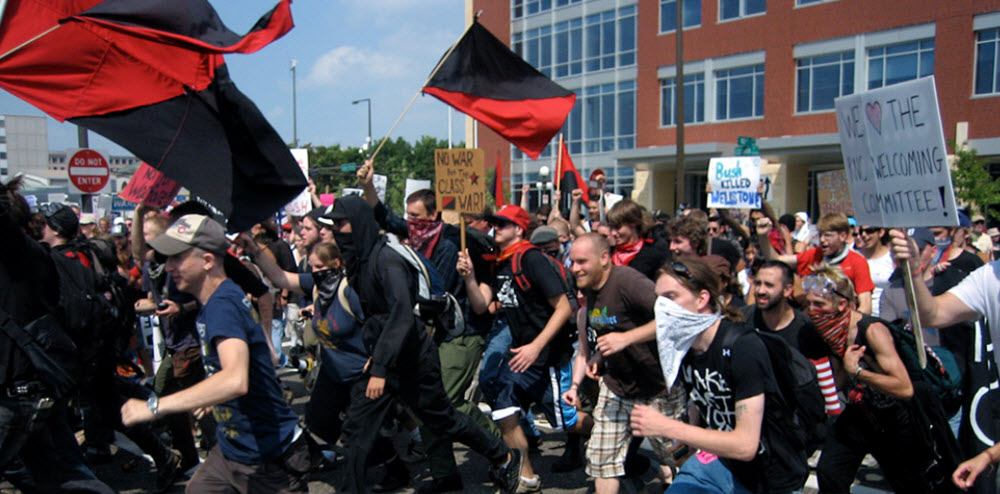
On November 30, several groups of individuals in black bloc attacked
various corporate targets in downtown Seattle. Among them were (to
name just a few):
Fidelity Investment (major investor in Occidental
Petroleum, the bane of the U'wa tribe in Columbia)
Bank of America, US Bancorp, Key Bank and Washington Mutual
Bank (financial institutions key in the expansion of corporate
repression)
Old Navy, Banana Republic and the GAP (as Fisher
family businesses, rapers of Northwest forest lands and sweatshop
laborers)
NikeTown and Levi's (whose overpriced products
are made in sweatshops)
McDonald's (slave-wage fast-food peddlers responsible
for destruction of tropical rainforests for grazing land and slaughter
of animals)
Starbucks (peddlers of an addictive substance
whose products are harvested at below-poverty wages by farmers who
are forced to destroy their own forests in the process)
Warner Bros. (media monopolists)
Planet Hollywood (for being Planet Hollywood)
This activity lasted for over 5 hours and involved the breaking
of storefront windows and doors and defacing of facades. Slingshots,
newspaper boxes, sledge hammers, mallets, crowbars and nail-pullers
were used to strategically destroy corporate property and gain access
(one of the three targeted Starbucks and Niketown were looted).
Eggs filled with glass etching solution, paint-balls and spray-paint
were also used.
The black bloc was a loosely organized cluster of affinity groups
and individuals who roamed around downtown, pulled this way by a
vulnerable and significant storefront and that way by the sight
of a police formation. Unlike the vast majority of activists who
were pepper-sprayed, tear-gassed and shot at with rubber bullets
on several occasions, most of our section of the black bloc escaped
serious injury by remaining constantly in motion and avoiding engagement
with the police. We buddied up, kept tight and watched each others'
backs. Those attacked by federal thugs were un-arrested by quick-thinking
and organized members of the black bloc. The sense of solidarity
was awe-inspiring.
THE PEACE POLICE
Unfortunately, the presence and persistence of "peace police" was quite disturbing.
On at least 6 separate occasions, so-called "non-violent" activists
physically attacked individuals who targeted corporate property.
Some even went so far as to stand in front of the Niketown super
store and tackle and shove the black bloc away. Indeed, such self-described
"peace-keepers" posed a much greater threat to individuals in the
black bloc than the notoriously violent uniformed "peace-keepers"
sanctioned by the state (undercover officers have even used the
cover of the activist peace-keepers to ambush those who engage in
corporate property destruction).
RESPONSE TO THE BLACK BLOC
Response to the black bloc has highlighted some of the contradictions and internal
oppressions of the "nonviolent activist" community. Aside from the
obvious hypocrisy of those who engaged in violence against black-clad
and masked people (many of whom were harassed despite the fact that
they never engaged in property destruction), there is the racism
of privileged activists who can afford to ignore the violence perpetrated
against the bulk of society and the natural world in the name of
private property rights. Window-smashing has engaged and inspired
many of the most oppressed members of Seattle's community more than
any giant puppets or sea turtle costumes ever could (not to disparage
the effectiveness of those tools in other communities).
TEN MYTHS ABOUT THE BLACK BLOC
Here's a little something to dispel the myths that have been circulating about
the N30 black bloc:
1. "They are all a bunch of Eugene anarchists." While a few may
be anarchists from Eugene, we hail from all over the United States,
including Seattle. In any case, most of us are familiar with local
issues in Seattle (for instance, the recent occupation of downtown
by some of the most nefarious of multinational retailers).
2. "They are all followers of John Zerzan." A lot of rumors have
been circulating that we are followers of John Zerzan, an anarcho-primitivist
author from Eugene who advocates property destruction. While some
of us may appreciate his writings and analyses, he is in no sense
our leader, directly, indirectly, philisophocally or otherwize.
3. "The mass public squat is the headquarters of the anarchists
who destroyed property on November 30th." In reality, most of the
people in the "Autonomous Zone" squat are residents of Seattle who
have spent most of their time since its opening on the 28th in the
squat. While they may know of one-another, the two groups are not
co-extensive and in no case could the squat be considered the headquarters
of people who destroyed property.
4. "They escalated situations on the 30th, leading to the tear-gassing
of passive, non-violent protesters." To answer this, we need only
note that tear-gassing, pepper-spraying and the shooting of rubber
bullets all began before the black blocs (as far as we know) started
engaging in property destruction. In addition, we must resist the
tendency to establish a causal relationship between police repression
and protest in any form, whether it involved property destruction
or not. The police are charged with protecting the interests of
the wealthy few and the blame for the violence cannot be placed
upon those who protest those interests.
5. Conversely: "They acted in response to the police repression."
While this might be a more positive representation of the black
bloc, it is nevertheless false. We refuse to be misconstrued as
a purely reactionary force. While the logic of the black bloc may
not make sense to some, it is in any case a pro-active logic.
6. "They are a bunch of angry adolescent boys." Aside from the
fact that it belies a disturbing ageism and sexism, it is false.
Property destruction is not merely macho rabble-rousing or testosterone-laden
angst release. Nor is it displaced and reactionary anger. It is
strategically and specifically targeted direct action against corporate
interests.
7. "They just want to fight." This is pretty absurd, and it conveniently
ignores the eagerness of "peace police" to fight us. Of all the
groups engaging in direct action, the black bloc was perhaps the
least interested in engaging the authorities and we certainly had
no interest in fighting with other anti-WTO activists (despite some
rather strong disagreements over tactics).
8. "They are a chaotic, disorganized and opportunistic mob." While
many of us could surely spend days arguing over what "chaotic" means,
we were certainly not disorganized. The organization may have been
fluid and dynamic, but it was tight. As for the charge of opportunism,
it would be hard to imagine who of the thousands in attendance _didn't_
take advantage of the opportunity created in Seattle to advance
their agenda. The question becomes, then, whether or not we helped
create that opportunity and most of us certainly did (which leads
us to the next myth):
9. "They don't know the issues" or "they aren't activists who've
been working on this." While we may not be professional activists,
we've all been working on this convergence in Seattle for months.
Some of us did work in our home-towns and others came to Seattle
months in advance to work on it. To be sure, we were responsible
for many hundreds of people who came out on the streets on the 30th,
only a very small minority of which had anything to do with the
black bloc. Most of us have been studying the effects of the global
economy, genetic engineering, resource extraction, transportation,
labor practices, elimination of indigenous autonomy, animal rights
and human rights and we've been doing activism on these issues for
many years. We are neither ill-informed nor unexperienced.
10. "Masked anarchists are anti-democratic and secretive because
they hide their identities." Let's face it (with or without a mask)--we
aren't living in a democracy right now. If this week has not made
it plain enough, let us remind you--we are living in a police state.
People tell us that if we really think that we're right, we wouldn't
be hiding behind masks. "The truth will prevail" is the assertion.
While this is a fine and noble goal, it does not jive with the present
reality. Those who pose the greatest threat to the interests of
Capital and State will be persecuted. Some pacifists would have
us accept this persecution gleefully. Others would tell us that
it is a worthy sacrifice. We are not so morose. Nor do we feel we
have the privilege to accept persecution as a sacrifice: persecution
to us is a daily inevitability and we treasure our few freedoms.
To accept incarceration as a form of flattery betrays a large amount
of "first world" privilege. We feel that an attack on private property
is necessary if we are to rebuild a world which is useful, healthful
and joyful for everyone. And this despite the fact that hypertrophied
private property rights in this country translate into felony charges
for any property destruction over $250.
MOTIVATIONS OF THE BLACK BLOC
The primary purpose of this communique is to diffuse some of the aura of mystery
that surrounds the black bloc and make some of its motivations more
transparent, since our masks cannot be.
ON THE VIOLENCE OF PROPERTY
We contend that property destruction is not a violent activity unless it destroys
lives or causes pain in the process. By this definition, private
property--especially corporate private property--is itself infinitely
more violent than any action taken against it.
Private property should be distinguished from personal property.
The latter is based upon use while the former is based upon trade.
The premise of personal property is that each of us has what s/he
needs. The premise of private property is that each of us has something
that someone else needs or wants. In a society based on private
property rights, those who are able to accrue more of what others
need or want have greater power. By extension, they wield greater
control over what others perceive as needs and desires, usually
in the interest of increasing profit to themselves.
Advocates of "free trade" would like to see this process to its
logical conclusion: a network of a few industry monopolists with
ultimate control over the lives of the everyone else. Advocates
of "fair trade" would like to see this process mitigated by government
regulations meant to superficially impose basic humanitarian standards.
As anarchists, we despise both positions.
Private property--and capitalism, by extension--is intrinsicly
violent and repressive and cannot be reformed or mitigated. Whether
the power of everyone is concentrated into the hands of a few corporate
heads or diverted into a regulatory apparatus charged with mitigating
the disasters of the latter, no one can be as free or as powerful
as they could be in a non-hierarchical society.
When we smash a window, we aim to destroy the thin veneer of legitimacy
that surrounds private property rights. At the same time, we exorcize
that set of violent and destructive social relationships which has
been imbued in almost everything around us. By "destroying" private
property, we convert its limited exchange value into an expanded
use value. A storefront window becomes a vent to let some fresh
air into the oppressive atmosphere of a retail outlet (at least
until the police decide to tear-gas a nearby road blockade). A newspaper
box becomes a tool for creating such vents or a small blockade for
the reclamation of public space or an object to improve one's vantage
point by standing on it. A dumpster becomes an obstruction to a
phalanx of rioting cops and a source of heat and light. A building
facade becomes a message board to record brainstorm ideas for a
better world.
After N30, many people will never see a shop window or a hammer
the same way again. The potential uses of an entire cityscape have
increased a thousand-fold. The number of broken windows pales in
comparison to the number broken spells--spells cast by a corporate
hegemony to lull us into forgetfulness of all the violence committed
in the name of private property rights and of all the potential
of a society without them. Broken windows can be boarded up (with
yet more waste of our forests) and eventually replaced, but the
shattering of assumptions will hopefully persist for some time to
come.
Against Capital and State,
the ACME Collective
"Peasant Revolt!"
-------------
Disclaimer: these observations and analyses represent only those
of the ACME Collective and should not be construed to be representative
of the rest of the black bloc on N30 or anyone else who engaged
in riot or property destruction that day.
last updated: December 29, 2004
|