|
|

Back to Table of Contents
This project arose during the run-up to June 18th, as a result of the need
felt by people with varying degrees of involvement with J18 to stimulate
critical debate around the politics behind the international day of action
in financial centres. Contributions were invited. The point was made that
this was not intended to be a discussion of the minutiae of the organisation
of the day or the effectiveness of particular tactics, although the line
between these questions and the “politics” of J18 is of course blurred.
Originally the idea was to produce the discussion booklet before the event.
It soon became apparent that this would not be feasible, nor necessarily
desirable. Many potential contributors wanted to see what happened on
the day and asked for more time to be able to reflect properly and chew
over how such a ‘day of action' could relate to capitalism and the movement
to overthrow it, the significance of the ‘globalization'-buzzword and
other issues raised by the whole process.
Deadlines passed and were extended, the e-mail system crashed and some
days' messages were lost forever - we just hope that no contributions
were sucked into that particular black hole in cyberspace! An open editorial
meeting was announced to decide the editorial policy and to coordinate
layout etc. Unfortunately because of space limitations we had to leave
out one lengthy contribution (the author made it clear that he did not
want his piece “Nine Meditations On a Summer's Day”, by Over The Water
Charlie, to be edited; however he agreed that if anyone's curiosity is
aroused they should write to Reclaim The Streets who will forward the
letter to him). So apart from that it only remains for us to thank everybody
who contributed and say “let the debate continue!”
Editorial Collective, October 1999
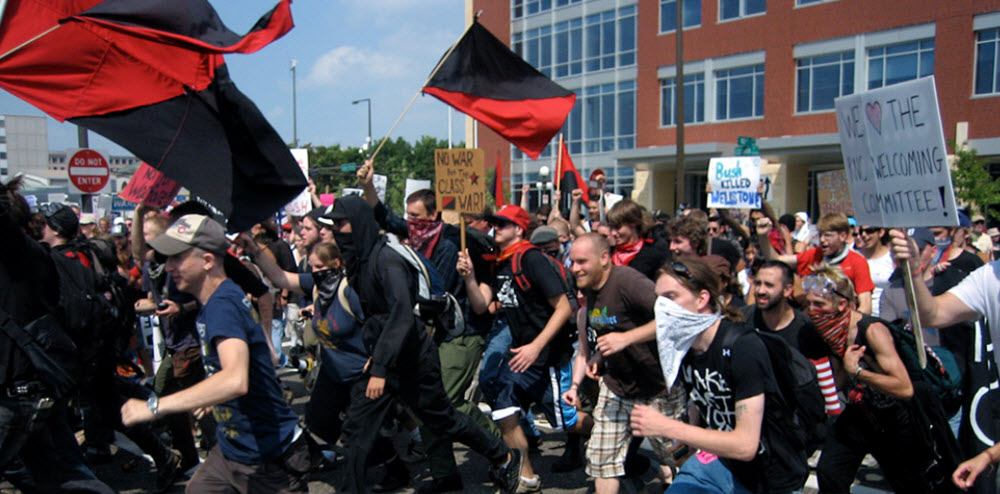
One problem apparent in the June 18th day of action was the adoption of an
activist mentality. This problem became particularly obvious with June
18th precisely because the people involved in organising it and the people
involved on the day tried to push beyond these limitations. This piece
is no criticism of anyone involved--rather an attempt to inspire some
thought on the challenges that confront us if we are really serious in
our intention of doing away with the capitalist mode of production.
Experts
By 'an activist mentality' what I mean is that people think of themselves primarily
as activists and as belonging to some wider community of activists. The
activist identifies with what they do and thinks of it as their role in
life, like a job or career. In the same way some people will identify
with their job as a doctor or a teacher, and instead of it being something
they just happen to be doing, it becomes an essential part of their self-image.
The activist is a specialist or an expert in social change. To think
of yourself as being an activist means to think of yourself as being somehow
privileged or more advanced than others in your appreciation of the need
for social change, in the knowledge of how to achieve it and as leading
or being in the forefront of the practical struggle to create this change.
Activism, like all expert roles, has its basis in the division of labour--it
is a specialised separate task. The division of labour is the foundation
of class society, the fundamental division being that between mental and
manual labour. The division of labour operates, for example, in medicine
or education--instead of healing and bringing up kids being common knowledge
and tasks that everyone has a hand in, this knowledge becomes the specialised
property of doctors and teachers--experts that we must rely on to do these
things for us. Experts jealously guard and mystify the skills they have.
This keeps people separated and disempowered and reinforces hierarchical
class society.
A division of labour implies that one person takes on a role on behalf
of many others who relinquish this responsibility. A separation of tasks
means that other people will grow your food and make your clothes and
supply your electricity while you get on with achieving social change.
The activist, being an expert in social change, assumes that other people
aren't doing anything to change their lives and so feels a duty or a responsibility
to do it on their behalf. Activists think they are compensating for the
lack of activity by others. Defining ourselves as activists means defining
*our* actions as the ones which will bring about social change, thus disregarding
the activity of thousands upon thousands of other non-activists. Activism
is based on this misconception that it is only activists who do social
change--whereas of course class struggle is happening all the time.
Form and Content
The tension between the form of 'activism' in which our political activity
appears and its increasingly radical content has only been growing over
the last few years. The background of a lot of the people involved in
June 18th is of being 'activists' who 'campaign' on an 'issue'. The political
progress that has been made in the activist scene over the last few years
has resulted in a situation where many people have moved beyond single
issue campaigns against specific companies or developments to a rather
ill-defined yet nonetheless promising anti-capitalist perspective. Yet
although the content of the campaigning activity has altered, the form
of activism has not. So instead of taking on Monsanto and going to their
headquarters and occupying it, we have now seen beyond the single facet
of capital represented by Monsanto and so develop a 'campaign' against
capitalism. And where better to go and occupy than what is perceived as
being the headquarters of capitalism--the City?
Our methods of operating are still the same as if we were taking on a
specific corporation or development, despite the fact that capitalism
is not at all the same sort of thing and the ways in which one might bring
down a particular company are not at all the same as the ways in which
you might bring down capitalism. For example, vigorous campaigning by
animal rights activists has succeeded in wrecking both Consort dog breeders
and Hillgrove Farm cat breeders. The businesses were ruined and went into
receivership. Similarly the campaign waged against arch-vivisectionists
Huntingdon Life Sciences succeeded in reducing their share price by 33%,
but the company just about managed to survive by running a desperate PR
campaign in the City to pick up prices.1
Activism can very successfully accomplish bringing down a business, yet
to bring down capitalism a lot more will be required than to simply extend
this sort of activity to every business in every sector. Similarly with
the targetting of butcher's shops by animal rights activists, the net
result is probably only to aid the supermarkets in closing down all the
small butcher's shops, thus assisting the process of competition and the
'natural selection' of the marketplace. Thus activists often succeed in
destroying one small business while strengthening capital overall.
A similar thing applies with anti-roads activism. Wide-scale anti-roads
protests have created opportunities for a whole new sector of capitalism--security,
surveillance, tunnellers, climbers, experts and consultants. We are now
one 'market risk' among others to be taken into account when bidding for
a roads contract. We may have actually assisted the rule of market forces,
by forcing out the companies that are weakest and least able to cope.
Protest-bashing consultant Amanda Webster says: "The advent of the
protest movement will actually provide market advantages to those contractors
who can handle it effectively."2
Again activism can bring down a business or stop a road but capitalism
carries merrily on, if anything stronger than before.
These things are surely an indication, if one were needed, that tackling
capitalism will require not only a quantitative change (more actions,
more activists) but a qualitative one (we need to discover some more effective
form of operating). It seems we have very little idea of what it might
actually require to bring down capitalism. As if all it needed was some
sort of critical mass of activists occupying offices to be reached and
then we'd have a revolution...
The form of activism has been preserved even while the content of this
activity has moved beyond the form that contains it. We still think in
terms of being 'activists' doing a 'campaign' on an 'issue', and because
we are 'direct action' activists we will go and 'do an action' against
our target. The method of campaigning against specific developments or
single companies has been carried over into this new thing of taking on
capitalism. We're attempting to take on capitalism and conceptualising
what we're doing in completely inappropriate terms, utilising a method
of operating appropriate to liberal reformism. So we have the bizarre
spectacle of 'doing an action' against capitalism--an utterly inadequate
practice.
Roles
The role of the 'activist' is a role we adopt just like that of policeman,
parent or priest--a strange psychological form we use to define ourselves
and our relation to others. The 'activist' is a specialist or an expert
in social change--yet the harder we cling to this role and notion of what
we are, the more we actually impede the change we desire. A real revolution
will involve the breaking out of all preconceived roles and the destruction
of all specialism--the reclamation of our lives. The seizing control over
our own destinies which is the act of revolution will involve the creation
of new selves and new forms of interaction and community. 'Experts' in
anything can only hinder this.
The Situationist International developed a stringent critique of roles
and particularly the role of 'the militant'. Their criticism was mainly
directed against leftist and social-democratic ideologies because that
was mainly what they encountered. Although these forms of alienation still
exist and are plain to be seen, in our particular milieu it is the liberal
activist we encounter more often than the leftist militant. Nevertheless,
they share many features in common (which of course is not surprising).
The Situationist Raoul Vaneigem defined roles like this: "Stereotypes
are the dominant images of a period... The stereotype is the model of
the role; the role is a model form of behaviour. The repetition of an
attitude creates a role." To play a role is to cultivate an appearance
to the neglect of everything authentic: "we succumb to the seduction
of borrowed attitudes." As role-players we dwell in inauthenticity--reducing
our lives to a string of clichés--"breaking [our] day down
into a series of poses chosen more or less unconsciously from the range
of dominant stereotypes."3 This process
has been at work since the early days of the anti-roads movement. At Twyford
Down after Yellow Wednesday in December '92, press and media coverage
focused on the Dongas Tribe and the dreadlocked countercultural aspect
of the protests. Initially this was by no means the predominant element--there
was a large group of ramblers at the eviction for example.4
But people attracted to Twyford by the media coverage thought every single
person there had dreadlocks. The media coverage had the effect of making
'ordinary' people stay away and more dreadlocked countercultural types
turned up--decreasing the diversity of the protests. More recently, a
similar thing has happened in the way in which people drawn to protest
sites by the coverage of Swampy they had seen on TV began to replicate
in their own lives the attitudes presented by the media as characteristic
of the role of the 'eco-warrior'.5
"Just as the passivity of the consumer is an active passivity, so
the passivity of the spectator lies in his ability to assimilate roles
and play them according to official norms. The repetition of images and
stereotypes offers a set of models from which everyone is supposed to
choose a role."6 The role of the militant or activist is just one
of these roles, and therein, despite all the revolutionary rhetoric that
goes with the role, lies its ultimate conservatism.
The supposedly revolutionary activity of the activist is a dull and sterile
routine--a constant repetition of a few actions with no potential for
change. Activists would probably resist change if it came because it would
disrupt the easy certainties of their role and the nice little niche they've
carved out for themselves. Like union bosses, activists are eternal representatives
and mediators. In the same way as union leaders would be against their
workers actually succeeding in their struggle because this would put them
out of a job, the role of the activist is threatened by change. Indeed
revolution, or even any real moves in that direction, would profoundly
upset activists by depriving them of their role. If *everyone* is becoming
revolutionary then you're not so special anymore, are you?
So why do we behave like activists? Simply because it's the easy cowards'
option? It is easy to fall into playing the activist role because it fits
into this society and doesn't challenge it--activism is an accepted form
of dissent. Even if as activists we are doing things which are not accepted
and are illegal, the form of activism itself the way it is like a job--means
that it fits in with our psychology and our upbringing. It has a certain
attraction precisely because it is not revolutionary.
We Don't Need Any More Martyrs
The key to understanding both the role of the militant and the activist is
self-sacrifice--the sacrifice of the self to 'the cause' which is seen
as being separate from the self. This of course has nothing to do with
real revolutionary activity which is the seizing of the self. Revolutionary
martyrdom goes together with the identification of some cause separate
from one's own life--an action against capitalism which identifies capitalism
as 'out there' in the City is fundamentally mistaken--the real power of
capital is right here in our everyday lives--we re-create its power every
day because capital is not a thing but a social relation between people
(and hence classes) mediated by things.
Of course I am not suggesting that everyone who was involved in June
18th shares in the adoption of this role and the self-sacrifice that goes
with it to an equal extent. As I said above, the problem of activism was
made particularly apparent by June 18th precisely because it was an attempt
to break from these roles and our normal ways of operating. Much of what
is outlined here is a 'worst case scenario' of what playing the role of
an activist can lead to. The extent to which we can recognise this within
our own movement will give us an indication of how much work there is
still to be done.
The activist makes politics dull and sterile and drives people away from
it, but playing the role also fucks up the activist herself. The role
of the activist creates a separation between ends and means: self-sacrifice
means creating a division between the revolution as love and joy in the
future but duty and routine now. The worldview of activism is dominated
by guilt and duty because the activist is not fighting for herself but
for a separate cause: "All causes are equally inhuman."7
As an activist you have to deny your own desires because your political
activity is defined such that these things do not count as 'politics'.
You put 'politics' in a separate box to the rest of your life--it's like
a job... you do 'politics' 9-5 and then go home and do something else.
Because it is in this separate box, 'politics' exists unhampered by any
real-world practical considerations of effectiveness. The activist feels
obliged to keep plugging away at the same old routine unthinkingly, unable
to stop or consider, the main thing being that the activist is kept busy
and assuages her guilt by banging her head against a brick wall if necessary.
Part of being revolutionary might be knowing when to stop and wait. It
might be important to know how and when to strike for maximum effectiveness
and also how and when NOT to strike. Activists have this 'We must do something
NOW!' attitude that seems fuelled by guilt. This is completely untactical.
The self-sacrifice of the militant or the activist is mirrored in their
power over others as an expert--like a religion there is a kind of hierarchy
of suffering and self-righteousness. The activist assumes power over others
by virtue of her greater degree of suffering ('non-hierarchical' activist
groups in fact form a 'dictatorship of the most committed'). The activist
uses moral coercion and guilt to wield power over others less experienced
in the theogony of suffering. Their subordination of themselves goes hand
in hand with their subordination of others--all enslaved to 'the cause'.
Self-sacrificing politicos stunt their own lives and their own will to
live--this generates a bitterness and an antipathy to life which is then
turned outwards to wither everything else. They are "great despisers
of life... the partisans of absolute self-sacrifice... their lives twisted
by their monstrous asceticism."8 We can see this in our own movement,
for example on site, in the antagonism between the desire to sit around
and have a good time versus the guilt-tripping build/fortify/barricade
work ethic and in the sometimes excessive passion with which 'lunchouts'
are denounced. The self-sacrificing martyr is offended and outraged when
she sees others that are not sacrificing themselves. Like when the 'honest
worker' attacks the scrounger or the layabout with such vitriol, we know
it is actually because she hates her job and the martyrdom she has made
of her life and therefore hates to see anyone escape this fate, hates
to see anyone enjoying themselves while she is suffering--she must drag
everyone down into the muck with her--an equality of self-sacrifice.
In the old religious cosmology, the successful martyr went to heaven.
In the modern worldview, successful martyrs can look forwards to going
down in history. The greatest self-sacrifice, the greatest success in
creating a role (or even better, in devising a whole new one for people
to emulate--e.g. the eco-warrior) wins a reward in history--the bourgeois
heaven.
The old left was quite open in its call for heroic sacrifice: "Sacrifice
yourselves joyfully, brothers and sisters! For the Cause, for the Established
Order, for the Party, for Unity, for Meat and Potatoes!"9
But these days it is much more veiled: Vaneigem accuses "young leftist
radicals" of "enter[ing] the service of a Cause--the 'best'
of all Causes. The time they have for creative activity they squander
on handing out leaflets, putting up posters, demonstrating or heckling
local politicians. They become militants, fetishising action because others
are doing their thinking for them."10
This resounds with us--particularly the thing about the fetishising of
action--in left groups the militants are left free to engage in endless
busywork because the group leader or guru has the 'theory' down pat, which
is just accepted and lapped up--the 'party line'. With direct action activists
it's slightly different--action is fetishised, but more out of an aversion
to any theory whatsoever.
Although it is present, that element of the activist role which relies
on self-sacrifice and duty was not so significant in June 18th. What is
more of an issue for us is the feeling of separateness from 'ordinary
people' that activism implies. People identify with some weird sub-culture
or clique as being 'us' as opposed to the 'them' of everyone else in the
world.
Isolation
The activist role is a self-imposed isolation from all the people we should
be connecting to. Taking on the role of an activist separates you from
the rest of the human race as someone special and different. People tend
to think of their own first person plural (who are you referring to when
you say 'we'?) as referring to some community of activists, rather than
a class. For example, for some time now in the activist milieu it has
been popular to argue for 'no more single issues' and for the importance
of 'making links'. However, many people's conception of what this involved
was to 'make links' with *other activists* and other campaign groups.
June 18th demonstrated this quite well, the whole idea being to get all
the representatives of all the various different causes or issues in one
place at one time, voluntarily relegating ourselves to the ghetto of good
causes.
Similarly, the various networking forums that have recently sprung up
around the country--the Rebel Alliance in Brighton, NASA in Nottingham,
Riotous Assembly in Manchester, the London Underground etc. have a similar
goal--to get all the activist groups in the area talking to each other.
I'm not knocking this--it is an essential pre-requisite for any further
action, but it should be recognised for the extremely limited form of
'making links' that it is. It is also interesting in that what the groups
attending these meetings have in common is that they are activist groups--what
they are actually concerned with seems to be a secondary consideration.
It is not enough merely to seek to link together all the activists in
the world, neither is it enough to seek to transform more people into
activists. Contrary to what some people may think, we will not be any
closer to a revolution if lots and lots of people become activists. Some
people seem to have the strange idea that what is needed is for everyone
to be somehow persuaded into becoming activists like us and then we'll
have a revolution. Vaneigem says: "Revolution is made everyday despite,
and in opposition to, the specialists of revolution."11
The militant or activist is a specialist in social change or revolution.
The specialist recruits others to her own tiny area of specialism in order
to increase her own power and thus dispel the realisation of her own powerlessness.
"The specialist... enrols himself in order to enrol others."12
Like a pyramid selling scheme, the hierarchy is self-replicating--you
are recruited and in order not to be at the bottom of the pyramid, you
have to recruit more people to be under you, who then do exactly the same.
The reproduction of the alienated society of roles is accomplished through
specialists.
Jacques Camatte in his essay 'On Organization' (1969)13
makes the astute point that political groupings often end up as "gangs"
defining themselves by exclusion--the group member's first loyalty becomes
to the group rather than to the struggle. His critique applies especially
to the myriad of Left sects and groupuscules at which it was directed
but it applies also to a lesser extent to the activist mentality.
The political group or party substitutes itself for the proletariat and
its own survival and reproduction become paramount--revolutionary activity
becomes synonymous with 'building the party' and recruiting members. The
group takes itself to have a unique grasp on truth and everyone outside
the group is treated like an idiot in need of education by this vanguard.
Instead of an equal debate between comrades we get instead the separation
of theory and propaganda, where the group has its own theory, which is
almost kept secret in the belief that the inherently less mentally able
punters must be lured in the organisation with some strategy of populism
before the politics are sprung on them by surprise. This dishonest method
of dealing with those outside of the group is similar to a religious cult--they
will never tell you upfront what they are about.
We can see here some similarities with activism, in the way that the
activist milieu acts like a leftist sect. Activism as a whole has some
of the characteristics of a "gang". Activist gangs can often
end up being cross-class alliances, including all sorts of liberal reformists
because they too are 'activists'. People think of themselves primarily
as activists and their primary loyalty becomes to the community of activists
and not to the struggle as such. The "gang" is illusory community,
distracting us from creating a wider community of resistance. The essence
of Camatte's critique is an attack on the creation of an interior/exterior
division between the group and the class. We come to think of ourselves
as being activists and therefore as being separate from and having different
interests from the mass of working class people.
Our activity should be the immediate expression of a real struggle, not
the affirmation of the separateness and distinctness of a particular group.
In Marxist groups the possession of 'theory' is the all-important thing
determining power--it's different in the activist milieu, but not that
different--the possession of the relevant 'social capital'--knowledge,
experience, contacts, equipment etc. is the primary thing determining
power.
Activism reproduces the structure of this society in its operations:
"When the rebel begins to believe that he is fighting for a higher
good, the authoritarian principle gets a filip."14 This is no trivial
matter, but is at the basis of capitalist social relations. Capital is
a social relation between people mediated by things--the basic principle
of alienation is that we live our lives in the service of some *thing*
that we ourselves have created. If we reproduce this structure in the
name of politics that declares itself anti-capitalist, we have lost before
we have begun. You cannot fight alienation by alienated means.
A Modest Proposal
This is a modest proposal that we should develop ways of operating that are
adequate to our radical ideas. This task will not be easy and the writer
of this short piece has no clearer insight into how we should go about
this than anyone else. I am not arguing that June 18th should have been
abandoned or attacked, indeed it was a valiant attempt to get beyond our
limitations and to create something better than what we have at present.
However, in its attempts to break with antique and formulaic ways of doing
things it has made clear the ties that still bind us to the past. The
criticisms of activism that I have expressed above do not all apply to
June 18th. However there is a certain paradigm of activism which at its
worst includes all that I have outlined above and June 18th shared in
this paradigm to a certain extent. To exactly what extent is for you to
decide.
Activism is a form partly forced upon us by weakness. Like the joint
action taken by Reclaim the Streets and the Liverpool dockers--we find
ourselves in times in which radical politics is often the product of mutual
weakness and isolation. If this is the case, it may not even be within
our power to break out of the role of activists. It may be that in times
of a downturn in struggle, those who continue to work for social revolution
become marginalised and come to be seen (and to see themselves) as a special
separate group of people. It may be that this is only capable of being
corrected by a general upsurge in struggle when we won't be weirdos and
freaks any more but will seem simply to be stating what is on everybody's
minds. However, to work to escalate the struggle it will be necessary
to break with the role of activists to whatever extent is possible--to
constantly try to push at the boundaries of our limitations and constraints.
Historically, those movements that have come the closest to de-stabilising
or removing or going beyond capitalism have not at all taken the form
of activism. Activism is essentially a political form and a method of
operating suited to liberal reformism that is being pushed beyond its
own limits and used for revolutionary purposes. The activist role in itself
must be problematic for those who desire social revolution.
Andrew X
You can contact the author of this piece via:
SDEF! c/o Prior House, Tilbury Place, Brighton BN2 2GY, UK
Notes
- Squaring up to the Square Mile: A Rough Guide
to the City of London (J18 Publications (UK), 1999) p. 8
- see 'Direct Action: Six Years Down the Road'
in Do or Die No. 7, p. 3
- Raoul Vaneigem - The Revolution of Everyday
Life, Trans. Donald Nicholson-Smith (Left Bank Books/Rebel
Press, 1994) - first published 1967, pp. 131-3
- see 'The Day they Drove Twyford Down' in Do
or Die No. 1, p. 11
- see 'Personality Politics: The Spectacularisation
of Fairmile' in Do or Die No. 7, p. 35
- Op. Cit. 2, p. 128
- Op. Cit. 2, p. 107
- Op. Cit. 2, p. 109
- Op. Cit. 2, p. 108
- Op. Cit. 2, p. 109
- Op. Cit. 2, p. 111
- Op. Cit. 2, p. 143
- Jacques Camatte - 'On Organization' (1969)
in This World We Must Leave and Other Essays (New York,
Autonomedia, 1995)
- Op. Cit. 2, p. 110
June 18th in the UK indicated once more that we have yet to realise the impasse
contained in a politics of carnival expressed in the form of a street
party. Indeed, I am going to suggest that the very concept of the street
party is, in its current guise, part of the difficulty, a contributory
factor to the spectacularisation of resistance which celebrates an idea
of ‘party as protest', thereby repeatedly mobilising the same constituency,
without appealing beyond a narrow sub-cultural ghetto. Where, in the past,
our critique has successfully illuminated the staid and self-disciplined
marches of other social movements, the purpose of which appears to all
intents and purposes to be the alienation of those participating, I want
to suggest that we are now in a similar position, having imposed our own
self discipline in what amounts to a carceral continuum of ‘protest'.
‘Participants' turn up at the meeting point, await instructions, follow
their leader(s), have a party, and express their frustration in the inevitable
confrontation with the police. Whether at London Wall or Upper Thames
Street, we still led, or were led (most peoples experience), to a space
which we accidentally liberated through force of numbers, before being
invited to trash something symbolic, and then either defend that space
with force from the police, or retreat under the threat of state intervention.
During all of this it was possible to ‘party' if you could get out of
the way of charging horses and baton wielding police. Despite having approximately
10,000 people in the City of London, only a handful of occupations took
place on the morning of June 18th, and the actions that were taken were
generalised in the sense that they were organised in established fashion,
CAAT actions involving locking on in banks, Critical Mass, etc. Despite
the notable attempts to block London Bridge most peoples involvement was
to choose to meet at Liverpool Street and await instructions, rather than
to plan their own autonomous actions. June 18th in London whether we liked
it or not was essentially an RTS, and was more revealing for being so.
Previously the action of blocking roads was in itself politically significant,
in rediscovering their potential as streets, the party became a celebration
of a world turned upside down, the liberation of enclosed space. However
in bringing the same tactic to the City, our challenge was not in the
decision to move from the pavement to the street, but from the street
in to the closed citadels of capital, and unfortunately many of us were
happier to stay in the street, excluded from the real party, that of the
owners of capital, rapidly enclosed, and then beaten down, our frustration
taken out in unimaginative graffiti - ‘bankers=wankers', the breaking
of windows, and the entirely bland re-enacting of iconic revolutionary
moments of the past. The burning of documents might have had greater resonance,
if it wasn't for its ritualised performance by a handful of militants
who entertained the crowd with their daring, but ultimately reaffirmed
their own separateness from those spectating. This was the theatre of
protest married to the spectacle of the party, the unrefined anomic disorder
of the dispossessed, frustrated and angry but ultimately controlled, allied
to the hedonism of the party scene which often perceives the political
as an ‘off yer face - out of mind' distraction. This is what I mean by
‘party as protest', it inverts Emma Goldman's often quoted affirmation
of revolution as a celebration, and replaces it with the conceit that
to party is revolutionary. I'm bored in every sense with ‘protest', the
very notion of a fragmentary objection to some ‘thing', and I celebrated
the repeated assertion of ‘resistance' in June 18 agit-prop, yet everywhere
I still hear the same mantra about ‘protest', as if it were possible to
protest against capitalism, to turn out for one day a year and object
to the very relationships within which the rest of our everyday lives
are embedded.
And, here lies some of the difficulty of the street party, difficulties
which have long since bedevilled a politics of carnival. Despite the wonderfully
erudite reading of carnival that has peppered RTS agit-prop, much of it
derived from Bakhtin, a street party is unlikely ever to become the revolutionary
moment, because it contains within it all the aspects of carnival which
have been, and continue to be recuperated within the spectacular, participants
in the street parties we organise have everything to gain by playing it
safe. Nowhere was this more evident than in the City. We have seen commentators
lamenting the police actions in breaking up a ‘peaceful party', and the
police in the City of London, despite our best imaginings, have given
us little indication that we are conceived as a serious threat, ultimately
they sat back and let us go where we pleased, not because they couldn't
stop us, but because we create the conditions of our own confinement.
When they wanted they were able to split the crowd, drive us away from
the LIFFE building and beat those who tried in vain to hold their ground.
Tactics which are reminiscent of the Met's recent handling of RTS events,
where they have deployed minimal control during the ‘rolling' stage of
the party, waiting until we're stopped and then surrounding us. What are
often celebrated as temporary autonomous zones, can just as easily be
conceived as prisons of our own choosing. The availability of between
5,000 and 10,000 people as a core constituency on any street party in
London means that the risk associated with attendance is minimal, minimal
risk - maximum attendance, yet there were 7,000 people 3 years ago, and
after months of work we can still only attract similar numbers, which
is far from a ‘critical mass'. Lots of symbolic actions, little meaningful
disruption for the City, and to make it worse we then congratulate ourselves
through commodifying our resistance, 2 million quid of damage - good demo!
Despite our good intentions party and carnival are not synonymous in the
context of the street party. Party here means the ‘party scene' and just
that, an opportunity to let off steam see your mates, get off your face
and go home, bar a few highly distinguished exceptions, the party scene
is a semi commercial enterprise run by entrepreneurs marketing a niche
in sub-cultural chic - witness the flyers distributed for pay parties
and whistles being sold to the crowd outside Liverpool St with little
challenge. What I want to know is where are the people that marched with
us to Trafalgar Square (accepting the failure of other plans for the day!)
on the March for Social Justice, the dockers, the RMT dissidents, disaffected
trade unionists, Kurdish workers, pensioners groups, twice the number
of people we attracted to the City. People whose tradition and history
speak volumes about differing forms of resistance, from whom we might
learn differing repertoires of activism and to whom we might teach certain
tactical innovations. The Inter Continental Caravan, should have raised
many questions for our movement in the UK. Why have we failed to mobilise
large swathes of people whose lives are touched everyday by the machinations
of the City, whose communities have long traditions of resistance and
whom we have worked with in the past.
Part of our difficulty is articulating a sustainable form of resistance
outside of activist ghettos, finding forms of engagement which enable
others to participate and constructing networks which go beyond those
already in place. The movement has diversified since the prominent mass
actions against road building, and whilst this diversification is healthy
in that it opens avenues of access to participation at different levels,
with differing emphases, drawing from differing traditions, if we are
to have further mass actions aimed at key nodes in the operation of finance
capital, part of this process has to be an escape from the well established
routine of the street party as it is enacted currently. Let me illustrate
the problem through reference to one of the key moments on June 18th in
London.
I was present outside the LIFFE building when there was an organised
attempt to gain access, despite the presence of long term activists, with
a significant history of engaging in direct action, many of whom I respect
enormously, they were met by other misguided people calling for ‘non-violence'
who, alongside the obligatory security, managed to physically obstruct
their attempts to gain entry, these confrontations opened the way for
the crude anarchism often displayed in such situations whose advocates
merely seek to smash things up and lob bottles from distances which imperil
those at the front, thereby bringing in the riot police, it also encouraged
the spectacle of protest, many happy to watch things develop despite being
implored to occupy the building. There was little resolve in those present
for an occupation, and yet with 100 or more people the building could
have easily been occupied and perhaps even barricaded, with greater enthusiasm
this could have been achieved with little in the way of violence and would
have sent a resounding message around the globe. So why didn't it happen?
Because the crowd gives the illusion of action but is essentially passive,
there is a ‘peaceful party' to be part of which seeks little in the way
of serious engagement, we are stuck between the virtual activism of the
party and the dedicated efforts of a far smaller number of activists whose
vision is of a revolutionary carnival. We have the ambition but the means
we have chosen dissipate our energy and allow our recuperation. Let's
not pretend any more that being forced away from the Futures Exchange
and smashing the odd Mercedes dealership is some kind of great success,
this is merely anomic disorder with little merit or conviction. We might
be able to mobilise 10,000 people but how many of them were willing to
take instrumental direct action which is aimed at the interference, disruption
and symbolic appropriation of key nodes in the operation of informationalised
capitalism, we have this capacity, and such as RAND (‘Cyberwar is Coming',
Arquilla and Rondfelt, 1993) have been theorising our capacity to cause
such immense disruption for years, yet still we engage in the same theatre
of collective action, tacitly affirming the relations of power to which
we are finally subjugated.
Suggestions for further mass actions.
If we are to hold further mass actions against finance capital they should
be explicitly targeted against key nodal points in the network of institutions,
corporations, and exchanges which facilitate the current globalisation
of neo-liberal capitalism, not at its totality which despite our understandings
of the ‘spectacle', or the ‘military/industrial/entertainment complex'
remains an abstract proposition for most people. This could involve a
call to stop a particular institution working for a day, a wonderfully
old fashioned mass picket (call it whatever you want) by the people whose
lives are affected in the everyday by its operation. We could explain
very clearly how the institution works and why it should be stopped, local
groups could research the impact it has in their region and tie it to
local pollution, poor working conditions, health and safety etc. Our energies
and resources could be focused on research to uncover every last detail
of their operations, it would be easily communicable through our own media
and quickly picked up by the external media post June 18. It would be
a return to the single issues that politicised so many of us previously,
but it would be the single issue of capitalism itself expressed in a less
abstract manner. We could target a different institution every six months,
explaining and demonstrating the links between them and calling for actions
against their offices or buildings globally. We could forget about the
secrecy of locations and be overt in our choice of target, those coming
to participate would know why they were there and it would be made apparent
that the aim was to shut the choice of target down. Tactics could involve
occupations (where possible), mass pickets (as carnivalesque as possible),
cyber attacks - hacking/fax attacks/e-mail bombs, phone actions, letter
writing campaigns, street parties outside Director's houses and wanted
posters of them in their own communities, etc etc. Instead of dissipating
our energies rallying against something so big it disappears, we would
be uniquely focused on the points at which their system is weakest.
Inevitably we would be the subject of massive police attention, but besieging
such institutions would allow for a clearer articulation of how capital
operates and the means of operation upon which it is dependent. Imagine
the police defending a sieged building of a major multi-national or financial
exchange when for weeks before local groups had distributed information
about how it effects the lives of people in their region, before going
to take part in the action. The police role as puppets of private capital
would be increasingly revealed to a wider constituency of support who
could participate in numerous ways, many people in our area would love
to participate but haven't reached the point where they can take to the
streets, there would be nothing to stop them phoning this or that institution/exchange
on the day. Unions could be contacted and sympathetic workers engaged
with, allowing for further information and possible internal disruption/sabotage.
This broadening of our support base would diminish the range of repressive
actions the police could take and might if we exhibited the same organisational
capacity as we did during June 18th, lead to them advising our targets
to cease work/dealing etc for the day. In the event of violence by the
police, the representation of a thin blue line sweeping a rabble from
the streets could not be sustained as easily, think of previous struggles
such as the miners strike, the printers at Wapping or even the poll tax
riot. If we can articulate a strong case why a particular corporation/exchange
should be stopped and threaten to lay siege to it, they will be forced
at some level to articulate a counter position. Once they engage in a
debate they effectively legitimate opposition, two positions are known
and people are able to side with one or the other, this strengthens us
immensely. The City was able to appear as sanctioning June 18th during
its ‘peaceful party' phase, before expressing shock at later events which
were represented as random and chaotic violence, they had no need to defend
their part in global death and destruction because they were never called
to do so. Trashing a Mercedes showroom, whilst it has my sympathy, is
not going to make others question the logic of capital, it's merely a
means of relieving frustration. We all know that stopping the City whilst
it sounds wonderful is unlikely to happen whilst we fail to engage those
outside our number who won't come for a party. However, stopping London
Clearing House or the Metals Exchange or the god forbid the Futures and
Options Exchange.... If we could stop them once it could be done again,
and if they can be stopped once the utopia of stopping them permanently
would appear almost in sight. Imagine 5 years from now when everyone knows
how the City operates because they've seen it sieged, exchange after exchange,
bank after bank, institution after institution. Imagine it permanently
cut off from the rest of London its own need for security strangling its
operation, whilst its reputation as a key player in the global network
of finance is devastated. Imagine the ripples it would send throughout
our networks, the same hope many of us have seen in the audacity and tactical
brilliance of the Zapatistas. It's possible but we need to move from a
celebration of its possibility to the enactment of its downfall.
There is nothing here which is at all innovative, I'm merely suggesting
a replication of tactics that have achieved differing degrees of success
elsewhere on a smaller scale, think of live animal exports or Hillgrove
and EF!'s national campaign against Tarmac. Neither am I calling for the
abandonment of RTS events, rather I'm attempting to suggest a way forward
from the impasse of challenging finance capital through the ‘party as
protest' route, which despite its ability to mobilise large numbers, does
so at the risk of inducing a political vacuum in the heart of our resistance.
As one of the people that occupied Freshfields law firm in the City of
London on June 18th, I found their own reporting of our action very telling:
"Freshfields has been stormed by the protesters waving banners and
playing bongo drums! The dancing is pretty dreadful but it's made for
an exciting morning' (Squall Web Site). The time of us dancing to their
tune should be over, I'm not interested in making their work exciting
- but stopping it. At the same time as our occupation and again over the
weekend, other activists from within the Lancaster J-18 group launched
a cyber attack against Freshfields which disabled their e-mail system,
whilst others still occupied Acordis Acetate's plant in Lancaster, leading
a critical mass there and storming the building. Acordis pump carcinogens
in to the air over Lancaster, and Freshfields are the lawyers that facilitated
them doing so. So when we danced in Freshfields it wasn't because we considered
that in itself was enough, but to celebrate the storm that was coming
their way. If we are to use the metaphor of carnival to frame our politics,
let's not have another carnival against capitalism, but turn capital in
to the carnival, juxtaposing its grotesque greed and excess, its viciousness
and inequity to our world of chaotic order and beautiful anarchy. Much
love from Lancaster.
G. Lancaster J-18 Collective.
~~~~~~~~~~~~~~~~~~~~~~~~~~~~~~~~~~~~~~~~~~~~~~~~~~~~~~~~~~~~~~~~~~~
General info: Reclaim the Streets: 0171 281 4621; rts@gn.apc.org
LONDON MEETING EVERY TUESDAY 7pm - Cock Tavern pub, Phoenix Road, Euston.
(Euston Tube)
###################################
June 18th 1999: for further info visit: www.j18.org
'''''''''''''''''''''''''''''''
For info on RTS, subscribe to <allsorts@gn.apc.org>,
specifying "RTS only"
To receive info on general direct action etc. stuff, subscribe to
<allsorts@gn.apc.org>,
specifying "allsorts"
'''''''''''''''''''''''''''''''
Reclaim the Streets: PO BOX 9656, London N4 4JY.
NOTE NEW WEBSITE ADDRESS! - http://www.gn.apc.org/rts/
~~~~~~~~~~~~~~~~~~~~~~~~~~~~~~~~~~~~~~~~~~~~~~~~~~~~~~~~~~~~~~~~~~~
last updated: December 29, 2004
|