|

January 10, 2001
Towards Anti-Racist Politics and Practice: a racial autobiography
by Chris Crass
part one: "Don't you know what color you are?"
As I walked that picket line, in front of the administration office, I could
feel the anxiety and tension growing. I knew that it would be unpopular to
protest for Chicano Studies at Fullerton College in Orange County,
California. But I wasn't prepared. I didn't know what to expect. I had
been to countless protests and actions over the years. Politicized at 15, I
went to protests against McDonald's and factory farming, Shell Oil and
apartheid, the Gulf War and militarism. But this was different and I wasn't
entirely sure why.
Let me give you some background. The protest for Chicano Studies was the
latest action of a student coalition that had formed a semester earlier, in
1993. When the student coalition first formed, the main priority was
fighting back against student fee increases. The State of California was
cutting the budget for higher education, as the prison budget swelled, and
the cut was being transferred to students as fee increases. The coalition
was largely made up of Chicano/a nationalists from MECHA and white
anarchists from the United Anarchist Front. We linked the fee hikes and the
cuts in education to the growing prison population. We put out flyers, put
together a couple of actions and we held a mass rally that was
overwhelmingly successful. In fact the rally was so successful that it
prompted some retaliation from the administration. During the rally, the
majority of speakers were people of color, which reflected who was in the
coalition. I was one of two white people who spoke at the rally and
actively participated in the coalition. A week or so after the rally, both
of us white students were called into the Dean of Students office.
I walked into the office, completely unaware of the reason why I was
summoned. When I sat down, there were two security guards sitting on both
sides of me. A secretary took notes of the meeting verbatim on a type
writer. The Dean of Students informed me that I had been spotted
vandalizing the school late at night with this other white student from the
coalition, who I honestly didn't really know. A custodian identified us
from pictures taken during the rally. We had supposedly been seen
wheatpasting huge posters of Governor Pete Wilson wearing Mickey Mouse ears.
I liked the poster, but had truthfully never put one up. The Dean told me
that as a result of this vandalism, I would be fined and expelled. My class
units made non-transferable, and I would be arrested at some point during
the week while I was in class. I couldn't believe it. I left that meeting
full of fear. When word spread in the coalition about what had happened,
David Rojas - one of the most amazing organizers I've even met - told me
that we were going to fight this. "They are trying to divide us," he said.
The administration targeted us for two reasons, I believe. They assumed
that it was the two white people who were leading the coalition and they
were afraid of multiracial organizing.
We put flyers out everywhere. We started up an underground newspaper called
the Molotov Cocktail - "serving one up for authority everywhere". The
school newspaper, the Hornet, loved us and every week printed articles about
us along with guest editorials and letters to the editor that we wrote. Our
demand to stop all fee hikes was widely supported by the students. The Dean
of Students eventually apologized for his accusations and nothing happened
to us. The semester was coming to an end. We had done some great work.
Towards the end of the semester, more and more ads began appearing in the
school newspapers about how fee hikes were the result of illegal
immigration. There were also student actions on other campuses calling for
more Ethnic Studies programs. At UCLA students had occupied an
administration building and then launched a successful hunger strike.
Over the summer a group of about 15 of us started a study group reading
Howard Zinn's "A People's History of the United States". Although the study
group itself didn't last very long, reading Zinn was a powerful experience
that opened my eyes to histories of race, class and gender oppression and
resistance. Over the summer, the coalition decided that our focus for the
next term was going to be Ethnic Studies and Women Studies generally and
Chicano Studies in particular. I had already taken the only Black Studies
class and Women Studies class at that point and was currently enrolled in
Chicano Studies. Eventually I majored in Race, Class, Gender and Power
Studies at San Francisco State University (a hybrid of Ethnic Studies, Women
Studies and Political Science), so Ethnic Studies was both personally and
politically significant for me. When thinking about this change in
priorities, it didn't occur to me that the response on campus would be
different. We were going from one important demand to another and I thought
people would continue supporting us. I was really naive about how big of a
decision it was to go from student fee hikes to Ethnic Studies, but I would
learn.
On September 16th of 1993, a rally had been called for Chicano Studies.
Busloads of high school students and college students from other campuses
were going to come to Fullerton College for a march. David Rojas and I
created a special issue of the Molotov Cocktail together (an 11x14 double
sider with 3 articles and graphics). We wrote, "Last semester, much of our
focus was directed on the rights of education for all. While we will
continue with this struggle, it is also equally important that we fight for
a quality education. We, as students, must remember that this is OUR
education and that we must have a role in shaping the education process."
We continued, "Fullerton College does not meet up to the state and federal
affirmative action guidelines and this effects us and our education. If
there are classes that are not available to us, then we must demand them.
We must reclaim our history! We must reclaim our education!" Of the last
56 people hired, only 6 were people of color. The college population was
57% Anglo, 22% Chicano/a, 12% Asian Pacific Islander, 3% African American
and 1% American Indian. There was not one full time African American
professor on the entire campus.
The rally happened, hundreds of students showed up and the energy was high.
There were Mexican flags and speeches in Spanish. The students began to
march into the streets of Orange County. It was energetic and peaceful.
Police in full riot gear were everywhere. The police surrounded the
students and ordered them to end the march. Shortly thereafter, the police
went wild with pepper spray and batons. High schoolers and college
students, almost entirely Latina/o, were hit and sprayed as they ran back to
the campus.
I missed the march. I had left the rally to go to work. It was a critical
mistake on my part to have left - regardless of work. I should have been
there. I was naive, and thought of this march as just one of many marches.
But the reality is this: when Latino/a students take to the streets of
Orange County, or anywhere in this country, it is different than when mostly
white activists do it. The threat of communities of color mobilized is
enormous and it scares the police to their bones. I had read about white
supremacy and called myself an anti-racist, but there was so much that I
just didn't understand.
The reaction on campus to the student march for Chicano Studies was
overwhelming negative. The school paper attacked the rally and march as
being "anti-white", "angry", "provoking violence" and "counter-productive".
The administration, the school paper and the overwhelming majority of white
students blamed our student coalition for the violence. Some called for
MECHA's funding to be cut, others blamed the Molotov Cocktail for urging
young students to use violence.
For weeks there was constant debate about Ethnic Studies. "We're not
protesting to have white studies", we were told over and over again.
"Chicano Studies is exclusive and narrow", we were informed. I was a white
student taking Chicano Studies and I tried to talk with other white students
about that. To discuss with them that Chicano Studies, like Western
Civilization class, was something for all of us to take. To talk about how
the history of Chicana/os was systematically eliminated from most classes -
not from conscious decision making necessarily, but because the ideology of
white supremacy says that there is nothing of Chicano history worthy of
study. This is why many of the white students would say things like, "the
books I read are written by white people, because that's who writes and
that's not my fault". This is how white supremacy operates - whiteness is
universalized as the norm of what is. It does not require a conscious
decision to have thoughts that are racist, as it is racism that shapes the
structure of our thought. "It is not my fault that Black people do not
write books." "It is not my fault that most of what is important was done
by Europeans and European Americans." "I believe that all people are
created equal, but it is not my fault that white people just do more". "We
are not studying white people, we are studying the presidents of the United
States and it is not my fault that they all happen to be white." White
supremacy is the tide that directs the flow of our thoughts. It does not
require us to go out of our way to be racist. It just requires that we go
with the flow of the status quo.
My job in the coalition was to try and talk with white people about this
stuff. I would write articles and identify myself as white, because white
students wanted to say that this was just a bunch of "crazy Mexicans". I
was white, and I was crazy, too.
This brings us back to the picket line in front of the administration
building. I could feel the anxiety and the tension growing. I was the only
white person in the picket line. A white friend of mine was coming with me,
but when he saw the picket line and all of the angry white students, he left
because he was afraid. I was scared too. By this point, our student
coalition, which had once enjoyed popular support, was being attacked from
all sides. The school paper slammed us for having abandoned "student
demands" (fee hikes) and taking on "exclusive and divisive self-interest
demands" (Chicano Studies). We had little support for our protest. Our
picket line was about 30 people, aside from myself, all Latina/o. We were
quickly surrounded by what seemed like hundreds of white students. They
were yelling at us - "Go home" and "We're not fighting for white studies".
I remember my sense of time changing - like slow motion - and hearing
students screaming at me, "what are you doing with them?", "don't you know
what color you are?", "you fucking traitor". It was surreal. I was really
scared, but I knew so strongly that I was on the right side of this picket
line.
The picket line has weighed heavy on my mind over the years. It made me
realize that I was white and it made me question what being white meant.
Why were those students yelling "don't you know what color you are?" I
began to realize that white supremacy is all about creating and maintaining
relationships of power based on skin color. White privilege is granted to
white people on the basis that they maintain loyalty to this system. It
doesn't require being an active racist per se, but just going with the flow.
For standing in solidarity with Latina/o students, I was being called out
as a traitor - I felt myself fearing physical attack from those white
students. Now I wonder about the other people who were in that picket line.
I was being denounced for organizing with Latina/o students, but I still
have no way of understanding what it was like for them. For me it was
experiencing the reality of racism in my face. David Rojas, my Chicano
nationalist mentor, broke the situation down and said, "this is what happens
to us all of the time". That picket line, that experience of struggling for
Ethnic Studies, of struggling for racial justice in a white supremacist
society was a catalyst that changed my life.
part two: Movement Building and Challenging White Supremacy
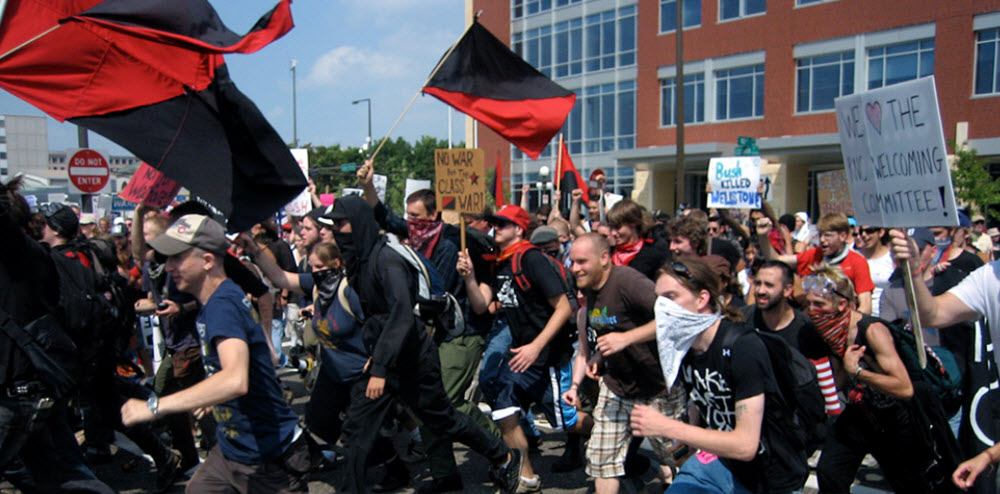
"We shut down the WTO!" I could hardly believe it when the news was spread
via messengers and mobile phones. Our blockades, our creative resistance,
our commitment to the earth and to justice had stopped the World Trade
Organization. November 30th, 1999, was also a day that changed my life. I
went to Seattle and joined with my affinity group of mostly San Francisco
Food Not Bombers. After years of using consensus decision making,
practicing civil disobedience and utilizing direct action, it was amazing to
see it come together on such a mass scale in Seattle.
Shortly thereafter, I read the essay by Elizabeth 'Betita' Martinez, "Where
was the Color in Seattle: Looking for reasons why the great battle was so
white". Martinez's essay struck a chord with me. For years I had studied
how race, class and gender have played out in social movements throughout
history. Racism and sexism have narrowed and undermined the labor movement.
White women suffragists of the late 1800's utilized racism to secure the
vote for white women. The sexism of the anti-war student movement catalyzed
the feminist movement. This history is vast and full of racism and other
forms of oppression undermining movements for social change. When I read
this history, I would think about organizing today and how to actively
challenge these barriers and obstacles to movement building. When Betita
called out the ways that racism operated in Seattle, I was floored. This is
how difficult it is to see and deconstruct racism and the complex way that
white privilege operates.
After Seattle, I spent a lot of time trying to figure out where to go. I had
spent the previous eight years working primarily with Food Not Bombs. For
two years I had been focusing more on developing as a writer. My overall
goal with both writing and organizing was to bridge race, class and gender
analysis of power with anarchist theory and practice. In the middle of
trying to make sense of what direction to move in, I had a dream.
It was a dream about power and the effects of internalized superiority on my
mind. The effect that white privilege has on white people is a developed
sense of internalized superiority over people of color. It need not be
conscious, nor spoken of directly, rather it is the framework of thought
that white supremacy develops in people. It is related to the way that male
privilege generates a sense of male superiority over women. So guys can
argue that men and women are equal, but still define reality through the
perspective of male privilege (i.e., it's not my fault that most of the good
books out there are written by men and that men do the most radical
activism).
My dream was of a party. A party of my friends. I was the only white,
male, middle class and (mostly) heterosexual person at the party. There
were women of color, transgendered men and women and queers, older people
and working class people and me. In the dream there were two lines of
thought going through my head. The first was straight up white supremacy,
patriarchy, heterosexism and it was telling me that my friends were not good
enough - as people, not as friends. Every imaginable hate word flooded my
mind. This calm, yet stern voice just repeated, "you know that these people
are inferior, you just can't admit it".
The other line of thought was that egalitarian relationships of power and
respect were both necessary and right, that these were my friends, people
who I care about, people who I am lucky to have in my life. When I thought
about this, about mutual respect and basic equality, my eyes dulled and my
jaw dropped and in my dream I turned into what looked like a zombie. When
my thoughts returned to the "inherent deficiencies" of my friends, my eyes
became clear and, over and over again, I heard that voice, "now you are
facing the truth". I woke up drenched in sweat, trying to catch my breath.
I spent several days trying to make sense of that dream, of that nightmare.
I kept thinking about consciousness and about how race, class and gender
oppression create both internalized inferiority and internalized
superiority. To oppose racism, one must also work to undermine the impact
racism has on one's way of seeing and being in the world. White privilege
functions in this way to both conceal and perpetuate racism - "It is not
that you are worse than me, it's just that I'm better than you". My dream
was about facing the truth of how domination distorts and disfigures one's
humanity. It led me to start writing about and thinking much more about the
process of decolonization for those who have been socialized to be in
positions of privilege. For years I've looked to the writings of women of
color feminists like Barbara Smith, bell hooks, Gloria Anzaldua, Patricia
Hill Collins, Elizabeth 'Betita' Martinez, M. Annette Jaimes, Karin
Aguilar-San Juan, Chinosole, Minoo Moallem, Audre Lorde, Cherrie Moraga and
Angela Davis to learn from, to gain wisdom and find inspiration and
guidance. I began struggling with how to use the concepts, tools, insights,
analysis, and perspectives to undermine internalized white superiority,
unmask white privilege and walk the paths toward a healing and healthy
humanity. The question has been what does anti-racist work look like for
white people and how do we do it?
I had been going to an anti-racism study group for about six months. Sharon
Martinas, of the Challenging White Supremacy Workshop, put the study group
together. It was a mostly white study group looking at anti-racism
organizing in predominately white communities. My favorite things about the
it was that it was multigenerational and that we were of multiple political
perspectives - feminist, marxist, anti-imperialist and/or anarchist.
Sharon Martinas has been doing anti-racism workshops and trainings in the
Bay Area for ten years. The Challenging White Supremacy Workshop was
designed as two fifteen week long sessions. Challenging White Supremacy for
activists and then CWS for organizers. One day on the way back from a study
group session, Sharon and I started to discuss putting together a workshop
series specifically for organizers in the anti-global capitalism movement.
Both Sharon and I were deeply inspired by Elizabeth 'Betita' Martinez's
essay "Where was the color in Seattle" and so we began putting together a
workshop called "Beyond the Whiteness in Seattle: challenging white
supremacy in the movements against global capitalism."
The workshop would be in four parts. We met on Tuesday nights during the
summer, leading up to the Democratic National Convention in Los Angeles. We
utilized role plays, homework, small group exercises, presentations and
discussions to look at how white supremacy impacts our work. We broke down
white supremacy into both racial oppression against communities of color and
white privilege that effects white communities. White privilege and racial
oppressions are two sides of the same coin; they both maintain systematic
inequality that punishes the majority of the planet and its inhabitants in
the service of profit and power. In the workshop we stress the importance
of overcoming feelings of guilt around racism and the need for action based
on the guideline that non-ruling class whites are both privileged and
oppressed.
I was really nervous doing this first session of workshops. Having been one
of the few white people in Ethnic Studies courses and often times one of the
only men in Women Studies classes. I was used to having people question my
motivations and intentions. I was used to people wondering, "what the hell
is that white guy doing here?" But I was nervous about how people would
react to "what the hell is this white guy doing co-training a course on
anti-racism?" I know that people are thinking this and frankly, I'd be kind
of worried if no one did. Facing contradictions, facing difficult
situations that make you feel awkward and vulnerable is the only way to do
this work.
Luckily, I was in the company of two mentors while doing this workshop
series: Sharon Martinas, who I was co-training with and who is an incredible
educator and organizer and Roxanne Dunbar-Ortiz, whose house we were using
for the workshop. Roxanne is a long time radical, historian and author who
has spent years doing anti-racist work. She started a group called Cell 16
in the late sixties that helped launch the women's liberation movement. She
has been doing solidarity work with indigenous groups resisting the United
States and she has been researching and writing about the impact of white
supremacy, patriarchy and capitalism on white people. I was glad we were
meeting at Roxanne's house as it was Roxanne who convinced me to go to
Seattle and bought me a plane ticket. She told me that it would change my
life, that all of the years of day-to-day organizing would manifest on the
streets and that I needed to be there. She was right. So there we were
doing an anti-racism training at her house, preparing for the DNC in LA.
Going to the Democratic National Convention in LA was a powerful experience
and it reconfirmed for me the importance of white people doing anti-racist
work. The workshops that Sharon and I do are directed primarily at other
white activists, and activists of color are always welcome to participate.
We do this because we believe that white radicals have a responsibility to
talk about and work on racism with white people; that it is not the
responsibility of activists of color to school white people. In Los Angeles
there was amazing organizing happening that actively combined international
issues of global capitalism with local struggles for justice. Many of the
local struggles were led by organizations of color. There was a lot of
confusion and debate about how the actions in LA went down. Why were there
legally permitted marches? Why weren't people doing massive civil
disobedience? This brought me back to thinking about the protests for
Ethnic Studies in Orange County, that action taken by people of color is
different than what white activists generally do. The stakes are higher,
and calls for justice in communities of color fundamentally challenge the
logic of white supremacy that says that people of color do not deserve
justice. I saw how important it was for white anti-racists to talk with
other white activists about this in LA and it is one of the reasons why I
continue doing the workshops here in San Francisco.
Since the four part workshop series, Sharon and I put together a six parter
of "Beyond the Whiteness" and I've done about a half-dozen one timers for
schools and conferences. The workshops have been really successful in terms
of getting people excited about this work and developing useful skills and
analysis. Out of the last workshop series, an on-going discussion group
(disco group) formed. The disco group's goals are to form a community of
learning, to have a peer group of organizers to look at how to incorporate
anti-racism into out projects, groups and campaigns and to train people to
do workshops themselves (creating agenda, exercies, timing discussions,
creating empowering group dynamics, etc.) The disco group is also helping
to develop a community of anti-racist activists.
One of the tactics utilized in the workshop that has been extremely useful
for myself and others is the "each one, teach one" model. Basically, Sharon
and I meet with people one on one and talk about anti-racism, about people's
organizing projects and offer feedback and help, when useful. It was used
extensively in the Southern Civil Rights movement as a way to not only teach
people and bring them into the movement, but also as a process of developing
relationships, trust and respect. For me, this is an extremely helpful way
for us to grow as a movement and for us to deepen the work that we do. Mass
actions and mass mobilizations are necessary, but we also need to do the
day-to-day work of sharing skills and building our capacities as organizers
and radicals. That's one of the biggest lessons of Seattle, for me. That
it's not just about large numbers of people, but that we are all active
participants in the movement.
Our strategy, as Challenging White Supremacy (CWS), is to do anti-racist
training and organizing specifically with predominately white grassroots
social justice activists. We also believe that multiracial, anti-racist
alliance building is at the core of doing this work. Our focus on
anti-racism with other white people is part of a long strategy of working
towards multiracial, anti-racist movement to oppose capitalism, white
supremacy, patriarchy and heterosexism.
To further this long-term strategy, several people started up a grassroots
network called Colours of Resistance (COR). Helen Luu, Pauline Hwang and
myself talked for about six months about wanting to see a stronger
commitment in the anti-global capitalism movement to anti-racist and
multiracial politics. We drafted up a Statement of COR, launched a webpage,
started up an email discussion group and we are all involved in local work
that reflects our politics. The idea behind COR: organizers of color
wanting to work in communities of color around these issues and wanting to
know that white anti-racists would be doing anti-racism work with
predominately white groups, with the goal of us all coming together to fight
the man. That is the basic strategy of COR, as it is with CWS. COR
provides a way for radicals of color and white radicals to share ideas,
stories, reflections, resources and build alliances through respect, trust
and friendship. While COR is a relatively small group of people (a couple
dozen) our goal is not related to numbers, but rather publicizing our
strategy and putting anti-racist, multiracial politics out into the broader
movement. So while I'm doing workshops and trainings, other COR folks are
doing work like teach-ins and educational work on the impact of global
capitalism on communities of color and resistance from communities of color
to global capitalism. Doing alliance-building work is critical for white
anti-racists, as white activists cannot and should not do this work alone.
So why do I do anti-racist work and why is it such a priority? Well, let me
tell you one more story. When I was in high school, I worked with a group
called the United Anarchist Front. We put out flyers, an underground
newspaper and organized actions. We did really cool work and it was fun.
But we would always talk about how apathetic the school was and how great it
would be to work with other people. Years later, I was looking at a copy of
our high school newspaper. I wrote a regular column called Love and Rage
(named after the anarchist paper out of New York City) about activism and
politics. Right next to my column was a guest editorial written by three
Latina women protesting that lack of coverage of the Latino student
population. They also called attention to the lack of coverage in the
yearbooks, the school videos and the overall disinterest shown by white
students in activities organized by the Spanish language club, Expanded
Horizons. Here were students that were angry and ready to take action about
issues impacting them on the campus.
I don't even remember reading that column in high school, let alone thinking
that our group should hook up with them. Their issues of language and
culture and representation didn't register for me. Their issues weren't
"radical" as I would have defined them in high school. This is an example of
how white privilege blinds white people and hurts the ability of white
radicals to act. I remember once we thought about translating one of our
flyers into Spanish, but we certainly didn't think that we might have
something to learn from those students, about conditions in the school,
about racism on campus and about what issues to organize around. How
radical would that have been if a group of white high schoolers worked in
solidarity with a group of Latina/o high schoolers to demand an end to
racism on campus! In a state like California, where a majority of voters
have passed anti-immigrant rights and anti-bilingual education measures,
such solidarity and anti-racist activism is critical.
Doing anti-racist work doesn't mean that we no longer make mistakes, but
rather that we are committed to doing this work, even though we will make
mistakes. I'm doing anti-racist organizing because I have hope for our
abilities to make history and transform this society. I have hope because
there is a radical vision of love at the heart of our movement and it is
growing. There is a long history of white supremacy undermining movements,
but together we can make anti-racism a catalyst for building ours. Our
movement is built day by day, with visions of the world we want seven
generations down the line.
For more information about anti-racism check out www.prisonactivist.org/cws
and www.tao.ca/~colours.
|