Propaganda of the Deed

From Infoshop OpenWiki

(Redirected from Propaganda of the deed)
Jump to: navigation, search

Contents

[edit] Propaganda of the Deed

Propaganda of the deed (or propaganda by the deed, from the French propagande par le fait) is a concept of anarchist origin. It involves individuals or groups doing actions or activities that promote the immitation of the activity and the values behind the activity. Anarchists practice propaganda of the deed by doing exemplary actions, sometimes directly associated to anarchists and their desires. Successful propaganda of the deed can create conversations and debates, cause copycats, gain solidarity activitities and grant a more positive image of the actor(s) and their movement. These are not universal qualities nor are they always popular. With society guided by spectacular images, anarchists practice propaganda of the deed to present an alternative to mass media through actions that expose anarchists and their ideas as positive.

Some theories on propaganda of the deed emphasize the actors do deeds with no ego and promote the action with only the action. Others feel that this may lead to misinterpretations and emphasize identifying the actions to the individuals or groups responsible and why. Sometimes this leads to the creation of communiques or other method of explanation, which is sometimes disseminated. Whether these communications end in the hands of the media isn't always determined by the actors, many times these communications are transmitted to the media by others that discovered the communication, for one reason or another.

Because propaganda of the deed functions outside of the constraints of mass media, giving the beholder an unmediated expression of our values, the perception of the deed is in competition with not just popular perceptions, but also how the deed is interpreted. When propaganda of the deed is interpreted by the any media, the same bias they view everything distorts, or mediates, the deed. This turns the action into another image separated from the public and intepretated by the media, not the actors. Some media attempt to broadcast deeds in a positive light, even seeing their group as propaganda of the deed, however the separation created by turning the action into yet another abstraction still doesn't emphasize the purpose of the deed as a promotion of itself.

In cases where the legality of the deed is in question, anarchists with concerns for their safety will usually not send their communications directly through a media source. When they do most attempt to take extreme precautions. Most forms of media have identifiable individuals and their security should be treated as an extension of the actor when directly communicated with. In these cases, if its possible for law enforcement to discover the source of the media, its also possible they can discover the actors.

[edit] Origin and Development of Propaganda of the Deed

Propaganda of the deed appeared towards the end of the 19th century, promoting actions that can shake the system as a way of inspiring the masses and catalyzing revolution.

There is no single definition of propaganda of the deed. Propaganda of the deed may take many forms, but in most cases utilizes violence against people seen as threats to the working class (such as Alexander Berkman's attempted assassination of Henry Clay Frick).

Due in particular to this concept of "propaganda of the deed", the anarchist movement has often been represented as violent and "terrorist", beginning with several bombings and assassinations at the end of the 19th century. This image has stuck, anarchists are still today often caricatured as wild-eyed fanatics with a stereotypical fuse-lit bomb.

An early proponent of propaganda by the deed was the Italian revolutionary Carlo Pisacane (1818-1857), who wrote in his "Political Testament" (1857) that "ideas spring from deeds and not the other way around." Mikhail Bakunin (1814-1876), in his "Letters to a Frenchman on the Present Crisis" (1870) stated that "we must spread our principles, not with words but with deeds, for this is the most popular, the most potent, and the most irresistible form of propaganda."[1]

The phrase "propaganda by the deed" was popularized by the French anarchist Paul Brousse (1844-1912). In his article of that name, published in the August 1877 Bulletin of the Jura Federation, he cited the 1871 Paris Commune, a workers' demonstration in Berne provocatively using the socialist red flag, and the Benevento uprising in Italy as examples of "propaganda by the deed."[2]

Some anarchists, such as Johann Most, advocated publicizing violent acts of retaliation against counter-revolutionaries because "we preach not only action in and for itself, but also action as propaganda."[3] Most was an early influence on American anarchists Emma Goldman and Alexander Berkman. Berkman attempted propaganda by the deed when he tried in 1892 to kill industrialist Henry Clay Frick following the shooting deaths of several striking workers.[4]

By the 1880s, the slogan "propaganda of the deed" had begun to be used both within and outside of the anarchist movement to refer to individual bombings, regicides and tyrannicides. However, as soon as 1887, important figures in the anarchist movement distanced themselves from such individual acts. Peter Kropotkin thus wrote that year in Le Révolté that "it is an illusion to believe that a few kilos of dynamite will be enough to win against the coalition of exploiters".[5] A variety of anarchists advocated the abandonment of these sorts of tactics in favor of collective revolutionary action, for example through the trade union movement. The anarcho-syndicalist, Fernand Pelloutier, argued in 1895 for renewed anarchist involvement in the labor movement on the basis that anarchism could do very well without "the individual dynamiter."[2]

State repression (including the infamous 1894 French lois scélérates) of the anarchist and labor movements following the few successful bombings and assassinations may have contributed to the abandonment of these kinds of tactics, although reciprocally state repression, in the first place, may have played a role in these isolated acts. The destructuration of the French socialist movement, divided into many groups, and, following the suppression of the 1871 Paris Commune, the execution and exile of many communards to penal colonies, favored individualist political expression and acts.[6]

Other theorists advocating propaganda of the deed included the Italian anarchists Luigi Galleani and Errico Malatesta. Malatesta described "propaganda by the deed" as violent communal insurrections that were meant to ignite the imminent revolution.[7] For the German anarchist Gustav Landauer "propaganda of the deed" meant the creation of libertarian social forms and communities that would inspire others to transform society.[8] In "Weak Statesmen, Weaker People," he wrote that the state is not something "that one can smash in order to destroy. The state is a relationship between human beings... one destroys it by entering into other relationships"[9]

In 1886, French anarchist Clément Duval achieved a form of propaganda of the deed stealing 15 000 francs from the mansion of a Parisian socialite, before accidentally setting the house on fire. Caught two weeks later, he was dragged from the court crying "Long live anarchy!", and condemned to death. His sentence was later commuted to hard labor on Devil's Island, French Guiana. In the anarchist paper Révolte, Duval famously declared that, "Theft exists only through the exploitation of man by man... when Society refuses you the right to exist, you must take it... the policeman arrested me in the name of the Law, I struck him in the name of Liberty".

Propaganda of the deed is also related to illegalism, an anarchist philosophy that developed primarily in France, Italy, Belgium, and Switzerland during the early 20th century as an outgrowth of anarchist individualism. The illegalists openly embraced criminality as a lifestyle. Influenced by theorist Max Stirner's concept of "egoism", the illegalists broke from anarchists like Clément Duval and Marius Jacob who justified theft with a theory of la reprise individuelle (Eng: individual reclamation). Instead, the illegalists argued that their actions required no moral basis - illegal acts were taken not in the name of a higher ideal, but in pursuit of one's own desires. France's Bonnot Gang was the most famous group to embrace illegalism.

[edit] Theorization of propaganda of the deed as a way to accelerate the coming of revolution

Propaganda of the deed thus included stealing (in particular bank robberies - named "expropriations" or "revolutionary expropriations" to finance the organization), rioting and general strikes which aimed at creating the conditions of an insurrection or even a revolution. These acts were justified as the necessary counterpart to state repression. As sociologist Max Weber had argued, the state has the "monopoly on the legitimate use of physical force", or, in Karl Marx's words, the state was only the repressive apparatus of the bourgeois class. Propaganda by the deed, including assassinations (sometimes involving bombs, named in French "machines infernales" - "hellish machines", usually made with bombs, sometimes only several guns assembled together), were thus legitimized by part of the anarchist movement and the First International as a valid means to be used in class struggle. The predictable state responses to these actions were supposed to display to the people the inherently repressive nature of the bourgeois state. This would in turn bolster the revolutionary spirit of the people, leading to the overthrow of the state. This is the basic formula of the cycle protests-repression-protests, which in specific conditions may lead to an effective state of insurrection.

This cycle has been observed during the 1905 Russian Revolution or in Paris in May 1968. However, it failed to achieve its revolutionary objective on the vast majority of occasions, thus leading to the abandonment by the vast majority of the anarchist movement of such bombings. However, the state never failed in its repressive response, enforcing various lois scélérates which usually involved tough clampdowns on the whole of the labor movement. These harsh laws, sometimes accompanied by the proclamation of the state of exception, progressively led to increased criticism among the anarchist movement of assassinations. The role of several agents provocateurs and the use of deliberate strategies of tension by governments, using false flag terrorist actions, work to discredit this violent tactic in the eyes of most socialist libertarians.

[edit] The abandonment of bombings, and new forms of propaganda of the deed

Propaganda of the deed, as a violent form of direct action involving bombings and targeted assassinations, was abandoned by the vast majority of the anarchist movement after World War I (1914-18) and the 1917 October Revolution. There are various causes for this, but important factors include state repression, the level of organization of the labour movement (in particular the new importance of anarcho-syndicalism in European Latin countries such as France, Italy and Spain) and the influence of the October Revolution. Although the Leninist thesis of an avant-garde party composed of professional revolutionaries didn't break that much with the Socialist-Revolutionary organization, it did make completely individual acts of propaganda of the deed less relevant. Despite this abandonment, the concept of propaganda of the deed remained popular in the anarchist movement, and thus influenced various social and cultural movements, including the Underground, during the 20th century.

For example, the concept of direct action itself continued to be central in anarchist movements, in particular the anarcho-syndicalism anarcho-syndicalist movement used the concept of the "revolutionary strike" inspired by French theorist Georges Sorel's Reflections on Violence (1908). In the 1950s, the Situationist International's conception of creating "situations" may be related quite easily to propaganda of the deed (which is not surprising, given the influence of council communism on Guy Debord). The autonomist movement and urban guerrilla group then took on the concept into the 1970s. It is also during this period that the concept of culture jamming, spass guerrilla, guerrilla communication and other kinds of non-violent and sometimes simultaneously artistic and political acts become popular as a new form of “direct action”.

[edit] Propaganda of the Deed Today

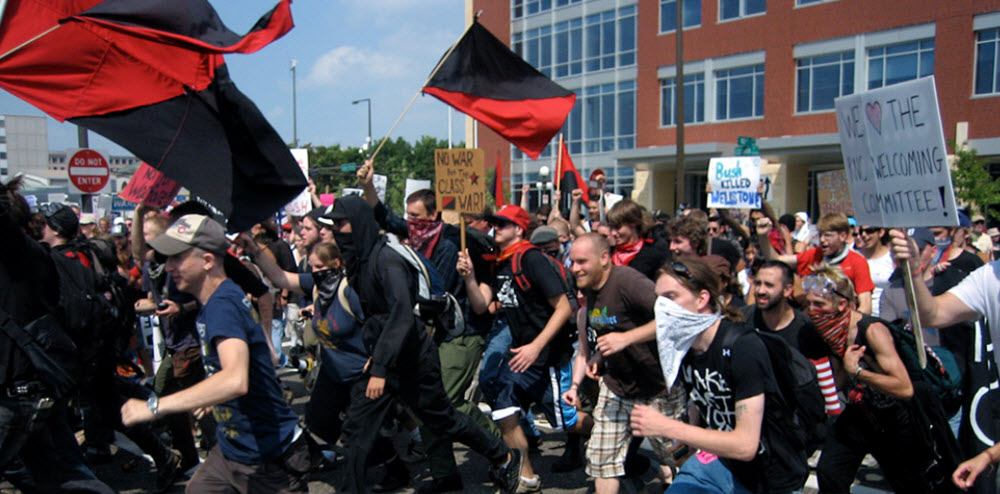
Contemporary uses of "propaganda of the deed" point away from an emphasis on violence (de-emphasizing its scale) and embrace individual and collective action as expressions of propaganda of the deed. While the importance of riots and rebellions in the creation of the conditions of an insurrection has never been abandoned, from anarcho-syndicalism to autonomism to today's anti-globalization Black blocs, anarchists find a variety of ways to show their practice. The anarchist cooperative movement refer to their co-ops being an example of propaganda of the deed. Other anarchists see the creation of mass or base organizations as examples of propaganda of the deed. This has expanded the relevance of the term, though "propaganda of the deed" is still used by anarchists and non-anarchists alike to denote taking nonsymbolic action, not only for its direct effects but also for its possible propagandistic effects.

[edit] References

  1. "Letter to a Frenchman on the Present Crisis" (1870) by Mikhail Bakunin
  2. Anarchism: A Documentary History of Libertarian Ideas
  3. "Action as Propaganda" by Johann Most, July 25, 1885
  4. Prison Memoirs of an Anarchist (1912) by Alexander Berkman
  5. Dynamite had been invented in 1862 by Nobel, who gave his name to the eponymous prize and... to the Nobel peace prize.
  6. Historian Benedict Anderson thus writes: "In March 1871 the Commune took power in the abandoned city and held it for two months. Then Versailles seized the moment to attack and, in one horrifying week, executed roughly 20,000 Communards or suspected sympathizers, a number higher than those killed in the recent war or during Robespierre’s ‘Terror’ of 1793–94. More than 7,500 were jailed or deported to places like New Caledonia. Thousands of others fled to Belgium, England, Italy, Spain and the United States. In 1872, stringent laws were passed that ruled out all possibilities of organizing on the left. Not till 1880 was there a general amnesty for exiled and imprisoned Communards. Meantime, the Third Republic found itself strong enough to renew and reinforce Louis Napoleon’s imperialist expansion—in Indochina, Africa, and Oceania. Many of France’s leading intellectuals and artists had participated in the Commune (Courbet was its quasi-minister of culture, Rimbaud and Pissarro were active propagandists) or were sympathetic to it. The ferocious repression of 1871 and after was probably the key factor in alienating these milieux from the Third Republic and stirring their sympathy for its victims at home and abroad." (in Benedict Anderson. "In the World-Shadow of Bismarck and Nobel", New Left Review, July -August 2004. ) According to some analysts, in post-war Germany, the prohibition of the Communist Party (KDP) and thus of institutional far-left political organization may also, in the same manner, have played a role in the creation of the Red Army Faction.
  7. "Violence as a Social Factor," (1895) by Malatesta
  8. Gustav Landauer, "Anarchism in Germany," 1895[1]
  9. Der Sozialist, 1910)

[edit] Sources

[edit] Bibliography

[edit] See also

The page was seeded with material from Wikipedia fr:Propagande par le fait

Personal tools