|

Buy
Infoshop gear and more at our online store.

Donate to Infoshop and Practical Anarchy magazine.
|


Democracy is Direct
by Cindy Milstein
These days, words seem to be thrown around like so much loose change.
Democracy is no exception.
We hear demands to "democraticize" the World Bank, IMF, and WTO. Some
contend that "democracy" is the standard for good government. Others allege
that "more," "better," or even "participatory democracy" is the needed
antidote to our woes. At the heart of these well-intentioned but misguided
sentiments beats a genuine desire: to gain control over our lives.
This is certainly understandable given the world in which we live.
Anonymous, often distant events and institutions--nearly impossible to
describe, much less confront--determine whether we work, drink clean water, or
have a roof over our heads. Most people feel that life isn't what it should
be; many go so far as to complain about "the government" or "corporations."
But beyond that, the sources of social misery are so masked they may even
look friendly: the Ben & Jerry's ice cream cone of "caring" capitalism or the
"humanitarian" gestures of Western superpowers.
Since the real causes appear untouchable and incomprehensible, people
tend to displace blame onto imaginary targets with a face: individuals rather
than institutions, people rather than power. The list of scapegoats is long:
from blacks and Jews, to single mothers and gays, and so on. It's much easier
to lash out at those who, like us, have little or no power. Hatred of the
visible "other" replaces social struggle against seemingly invisible systems
of oppression. A longing for community--a place where we can take hold of our
own lives, share it with others, and build something of our own choosing--is
being distorted around the globe into nationalisms, fundamentalisms,
separatisms, and the resultant hate crimes, genocides, and ethnic cleansings.
Community no longer implies a rich recognition of the self and society; it
translates into a battle unto death between one tiny "us" against another
small "them," as the wheels of domination roll over us all. The powerless
trample the powerless, while the powerful go largely unscathed.
We are left with a few bad choices, framed for us by the powers that
be. In a Nation article, Slavoj i ek termed this the "double blackmail" in
relation to last year's Kosovo conflict: if you opposed air strikes, you lent
tacit support to Milosevic's authoritarian regime of ethnic cleansing; if you
condemned Milosevic, you stood behind a world molded by global capital. This
choiceless choice applies to many other contemporary crises as well.
Genocides seem to necessitate nation-state interventions; the excesses of
free trade seem to call for international regulatory bodies. If the right
answer, from an ethical point of view, lies outside this picture altogether,
what of it? It's all talk when people are dying or the environment is being
destroyed. At least that's what common wisdom purports, from government
officials to news commentators to the average person on the street.
Even much of the Left can see no other "realistic" choices to control
an out-of-control world than those that are presented to us from on high.
Given this, the leftist horizon narrows to what's allegedly achievable: NGO
or Two-Thirds World participation in international decision-making bodies;
accountability and openness in nation-states; the rectification of the wrongs
of capitalism. These and other such demands are bare minimums within the
current system. Yet they are a far cry from any sort of liberatory response.
They work with a circumscribed and neutralized notion of democracy, where
"democracy" is neither of the people, by the people, nor for the people, but
rather, only in the supposed name of the people. What gets dubbed
"democracy," then, is mere representation, and the best that progressives and
leftists can advocate for within the confines of this prepackaged definition
are improved versions of a fundamentally flawed system.
"The moment a people gives itself representatives, it is no longer
free," famously proclaimed Jean-Jacques Rousseau in On the Social Contract.
Freedom, particularly social freedom, is indeed utterly anthetical to a
state, even a representative one. At the most basic level, representation
"asks" that we give our freedom away to another; it assumes, in essence, that
some should have power and many others shouldn't. Without power, equally
distributed to all, we renounce our very capacity to join with everyone else
in meaningfully shaping our society. We renounce our ability to
self-determine, and thus our liberty. And so, no matter how enlightened
leaders may be, they are governing as tyrants nonetheless, since we--"the
people"--are servile to their decisions.
This is not to say that representative government is comparable with
more authoritarian forms of rule. A representative system that fails in its
promise of, say, universal human rights is clearly preferable to a government
that makes no such pretensions at all. Yet even the kindest of representative
systems necessarily entails a loss of liberty. Like capitalism, a grow-or-die
imperative is built into the state's very structure. As Karl Marx explained
in Capital, capitalism's aim is--in fact, has to be--"the unceasing movement
of profit- making." So, too, is there such an aim underlying the state: the
unceasing movement of power making. The drive for profit and the drive for
power, respectively, must become ends in themselves. For without these
drives, we have neither capitalism nor the state; these "goals" are part of
their body constitution. Hence, the two often interlinked systems of
exploitation and domination must do whatever is necessary to sustain
themselves, otherwise they are unable to fulfill their unceasing momentum.
Whatever a state does, then, has to be in its own interests.
Sometimes, of course, the state's interests coincide with the interests of
various groups or people; they may even overlap with concepts such as justice
or compassion. But these convergences are in no way central or even essential
to its smooth functioning. They are merely instrumental stepping-stones as
the state continually moves to maintain, solidify, and consolidate its power.
Because, like it or not, all states are forced to strive for a
monopoly on power. "The same competition," wrote Mikhail Bakunin in Statism
and Anarchism, "which in the economic field annihilates and swallows up small
and even medium-sized capital . . . in favor of vast capital . . . is also
operative in the lives of the States, leading to the destruction and
absorption of small and medium-sized States for the benefit of empires."
States must, as Bakunin noted, "devour others in order not to be devoured."
Such a power-taking game will almost invariably tend toward centralization,
hegemony, and increasingly sophisticated methods of command, coercion, and
control. Plainly, in this quest to monopolize power, there will always have
to be dominated subjects.
As institutionalized systems of domination, then, neither state nor
capital are controllable. Nor can they be mended or made benign. Thus, the
rallying cry of any kind of leftist or progressive activism that accepts the
terms of the nation-state and/or capitalism is ultimately only this: "No
exploitation without representation! No domination without representation!"
Direct democracy, on the other hand, is completely at odds with both
the state and capitalism. For as "rule of the people" (the etymological root
of democracy), democracy's underlying logic is essentially the unceasing
movement of freedom making. And freedom, as we have seen, must be jettisoned
in even the best of representative systems.
Not coincidentally, direct democracy's opponents have generally been
those in power. Whenever "the people" spoke--as in the majority of those who
were disenfranchised, disempowered, or even starved--it usually took a
revolution to work through a "dialogue" about democracy's value. As a direct
form of governance, therefore, democracy can be nothing but a threat to those
small groups who wish to rule over others: whether they be monarchs,
aristocrats, dictators, or even federal administrations as in the United
States.
Indeed, we forget that democracy finds its radical edge in the great
revolutions of the past, the American Revolution included. As political
actors in the United States, it seems particularly appropriate to harken to
those strains of a radicalized democracy that fought so valiantly and lost so
crushingly in the American Revolution. We need to take up that unfinished
project if we have any hope of contesting domination itself.
This does not mean that the numerous injustices tied to the founding
of the United States should be ignored or whitewashed. The fact that native
peoples, blacks, women, and others were (and often continue to be) excluded,
brutalized, and/or exploited wasn't just a sideshow to the historic event
that created this country. Any movement for direct democracy has to grapple
with the relation between this oppression and the liberatory moments of the
American Revolution.
At the same time, one needs to view the revolution in the context of
its times and ask, In what ways was it an advance? Did it offer glimpses of
new freedoms, ones that we should ultimately extend to everyone? Like all the
great modern revolutions, the American Revolution spawned a politics based on
face-to-face assemblies confederated within and between cities.
"American democratic polity was developed out of genuine community
life. . . . The township or some not much larger area was the political unit,
the town meeting the political medium, and roads, schools, the peace of the
community, were the political objectives," according to John Dewey in The
Public and Its Problems. This outline of self-governance did not suddenly
appear in 1776. It literally arrived with the first settlers, who in being
freed from the bonds of Old World authority, decided to constitute the rules
of their society anew in the Mayflower Compact. This and a host of other
subsequent compacts were considered mutual promises--of both rights and
duties--on the part of each person to their community, a promise initially
emanating out of newfound egalitarian religious values. The idea caught on,
and many New England villages drafted their own charters and
institutionalized direct democracy through town meetings, where citizens met
regularly to determine their community's public policy and needs.
Participating in the debates, deliberations, and decisions of one's
community became part of a full and vibrant life; it not only gave colonists
(albeit, mostly men) the experience and institutions that would later support
their revolution but also a tangible form of freedom worth fighting for.
Hence, they struggled to preserve control over their daily lives: first with
the British over independence, and later, among themselves over competing
forms of governance. The final constitution, of course, set up a federal
republic not a direct democracy. But before, during, and after the
revolution, time and again, town meetings, confederated assemblies, and
citizens' militias either exerted their established powers of self-management
or created new ones when they were blocked--in both legal and extralegal
institutions--becoming ever more radical in the process.
We have inherited this self-schooling in direct democracy, even if
only in vague echoes like New Hampshire's "live free or die" motto or
Vermont's yearly Town Meeting Day. Such institutional and cultural fragments,
however, bespeak deep-seated values that many in the United States still hold
dear: independence, initiative, liberty, equality. They continue to create a
very real tension between grassroots self-governance and top-down
representation--a tension that we, as modern-day revolutionaries, need to
build on.
Such values resonate through the history of the American Left: from
nineteenth-century experiments in utopian communities, to the civil rights
movement's struggle for social freedom, to the Students for a Democratic
Society's demands for a participatory democracy in the 1960s, to the
anarchist-inspired affinity group organizing of the 1970s' antinuke movement
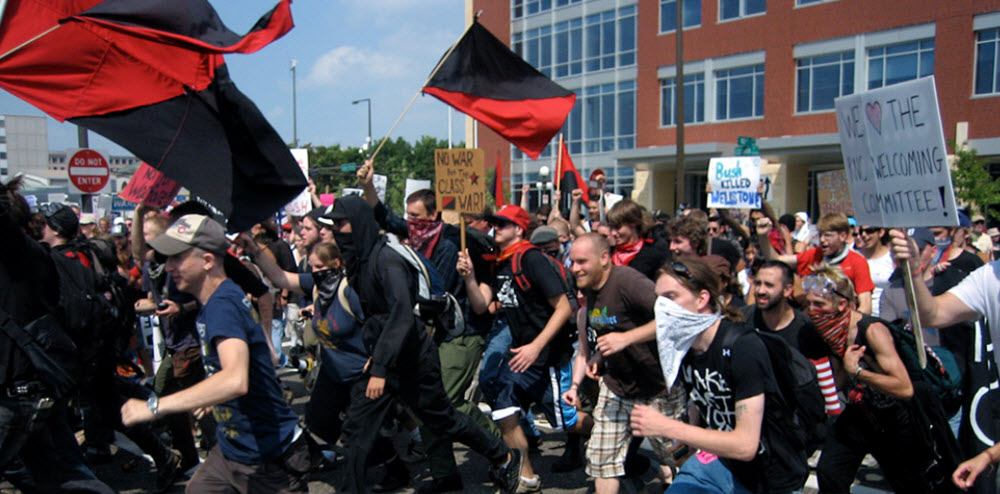
and last year's Seattle action. In both its principles and practices, the
U.S. Left has been inventive and dynamic, particularly in the postwar era.
We've challenged multiple "isms," calling into question old privileges and
dangerous exclusions. We've created a culture within our own organizations
that nearly mandates, even if it doesn't always work, an internally
democratic process. We're pretty good at organizing everything from
demonstrations to counterinstitutions.
This is not to romanticize the past or present work of the Left;
rather, it is to point out that we, too, haven't lacked a striving for the
values underpinning this country's birth. Then and now, however, one of our
biggest mistakes has been to ignore politics per se--that is, the need for a
guaranteed place for freedom to emerge.
The Clash sang years ago of "rebels dancing on air," and it seems we
have modeled our political struggles on this. We may feel free or powerful in
the streets, at our infoshops, within our collective meetings, but this is a
momentary and often private sensation. It allows us to be political, as in
reacting to, opposing, countering, or even trying to work outside public
policy. But it does not let us do politics, as in making public policy
itself. It is only "freedom from" those things we don't like, or more
accurately, liberation.
"Liberation and freedom are not the same," contended Hannah Arendt in
On Revolution. Certainly, liberation is a basic necessity: people need to be
free from harm, hunger, and hatred. But liberation falls far short of
freedom. If we are ever to fulfill both our needs and desires, if we are ever
to take control of our lives, each and every one of us needs the "freedom to"
self-develop--individually, socially, and politically. As Arendt added:
"[Liberation] is incapable of even grasping, let alone realizing, the central
idea of revolution, which is the foundation of freedom."
The revolutionary question becomes: Where do decisions that affect
society as a whole get made? For this is where power resides. It is time we
opened the doors of that house to everyone. For only when we all have equal
and ongoing access to participate in the space where public policy is
made--the political sphere--will freedom have a fighting chance to gain a
footing.
Montesquieu, one of the most influential theorists for the American
revolutionists, tried to wrestle with "the constitution of political freedom"
in his monumental The Spirit of the Laws. He came to the conclusion that
"power must check power." In the postrevolutionary United States, this idea
eventually made its way into the Constitution as a system of checks and
balances. Yet Montesquieu's notion was much more expansive, touching on the
very essence of power itself. The problem is not power per se but power
without limits. Or to press Montesquieu's concept, the problem is power as an
end in itself. Power needs to be forever linked to freedom; freedom needs to
be the limit placed on power. Tom Paine, for one, brought this home to the
American Revolution in The Rights of Man: "Government on the old system is an
assumption of power for the aggrandizement of itself; on the new, a
delegation of power for the common benefit of society."
If freedom is the social aim, power must be held horizontally. We
must all be both rulers and ruled simultaneously, or a system of rulers and
subjects is the only alternative. We must all hold power equally in our hands
if freedom is to coexist with power. Freedom, in other words, can only be
maintained through a sharing of political power, and this sharing happens
through political institutions. Rather than being made a monopoly, power
should be distributed to us all, thereby allowing all our varied "powers" (of
reason, persuasion, decision making, and so on) to blossom. This is the power
to create rather than dominate.
Of course, institutionalizing direct democracy assures only the
barest bones of a free society. Freedom is never a done deal, nor is it a
fixed notion. New forms of domination will probably always rear their ugly
heads. Yet minimally, directly democratic institutions open a public space in
which everyone, if they so choose, can come together in a deliberative and
decision-making body; a space where everyone has the opportunity to persuade
and be persuaded; a space where no discussion or decision is ever hidden, and
where it can always be returned to for scrutiny, accountability, or
rethinking. Embryonic within direct democracy, if only to function as a truly
open policymaking mechanism, are values such as equality, diversity,
cooperation, and respect for human worth--hopefully, the building blocks of a
liberatory ethics as we begin to self-manage our communities, the economy,
and society in an ever widening circle of confederated citizen assemblies.
As a practice, direct democracy will have to be learned. As a
principle, it will have to undergird all decision making. As an institution,
it will have to be fought for. It will not appear magically overnight.
Rather, it will emerge little by little out of struggles to, as Murray
Bookchin phrased it, "democratize the republic, radicalize our democracy."
We must infuse all our political activities with politics. It is time
to call for a second American Revolution, but this time, one that breaks the
bonds of nation-states, one that knows no borders or masters, and one that
draws the potentiality of libertarian self-governance to its limits, fully
enfranchising all with the power to act democratically. This begins with
reclaiming the word democracy itself--not as a better version of
representation but as a radical process to directly remake our world.


last updated: February 6, 2006
|